Board Meetings and Resolutions: Legal Requirements
By Adv. Saravvanan R, Advocate · Reviewed by Advocate · Updated · 12 min read · Business & Commercial Litigation
Short answer
Under the Companies Act, 2013, a company must hold its first board meeting within 30 days of incorporation and at least four meetings a year, with no more than 120 days between two. Resolutions need proper notice, quorum and minutes, following Secretarial Standard 1.
Board Meetings and Resolutions - The Companies Act, 2013 establishes essential requirements for conducting valid Board meetings in India. Every company generally holds its first Board meeting within thirty days after incorporation. Thereafter, the Board ordinarily conducts at least four meetings annually. The gap between consecutive meetings should not exceed 120 days. However, statutory exemptions apply to certain companies and circumstances. Directors may participate through video conferencing or approved audio-visual means. Therefore, companies should maintain reliable records of participation and proceedings. The Companies Act also recognizes Board powers, quorum, disclosure of interest, and resolutions passed through circulation. Additionally, Revised Secretarial Standard-1 governs Board meeting procedures from 1 April 2024. Consequently, companies should align notices, agendas, attendance, voting, minutes, and records with applicable statutory requirements.
Board Meetings and Resolutions: Legal Requirements and Minutes - Empower Legal - Corporate Law Firm
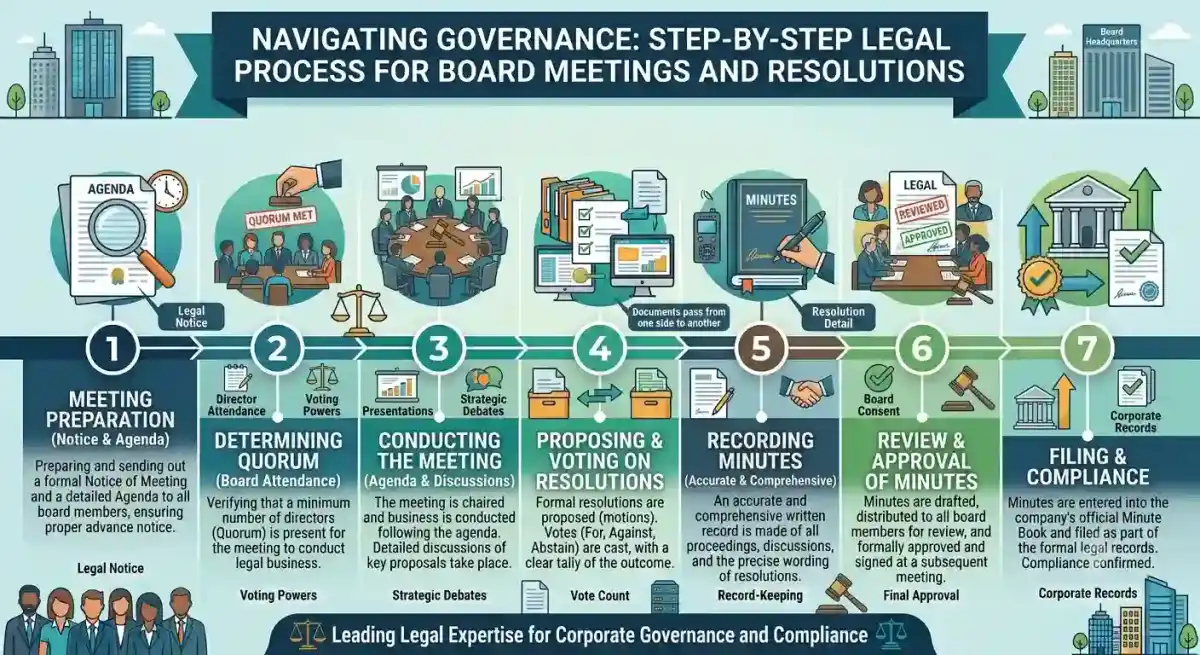
Notice, Agenda, and Meeting Documentation
Preparing Legally Compliant Board Notices
Proper notice forms an important foundation for a valid Board meeting. The company should issue notice to every director according to applicable statutory requirements. Furthermore, the notice should communicate the meeting date, time, venue, and relevant participation details. The agenda should provide sufficient information for directors to evaluate proposed decisions. Supporting documents should accompany agenda items requiring detailed consideration. Consequently, directors can assess financial, regulatory, contractual, and governance implications before voting. Companies should also maintain evidence showing delivery of notices and supporting materials. Defective notice practices may create governance disputes and challenge the validity of decisions. Therefore, professional corporate legal support helps companies establish consistent notice procedures. Empower Legal - Corporate Law Firm assists companies with Board notices, agenda preparation, compliance reviews, legal opinions, meeting procedures, and corporate governance documentation across Chennai and India.
Quorum, Attendance, and Director Participation
Board meetings require proper quorum before directors can validly transact business. Section 174 of the Companies Act addresses Board meeting quorum requirements. Accordingly, companies must verify director attendance before commencing substantive business. Directors may participate physically or through permitted electronic means. However, companies must consider statutory restrictions affecting particular matters and participation methods. Attendance registers should accurately identify participating directors and relevant meeting details. Moreover, directors with conflicts should disclose their interests according to applicable law. Such disclosures support transparent decision-making and reduce corporate governance risks. Companies should preserve attendance records alongside notices, agendas, supporting papers, and minutes. Therefore, careful meeting administration protects directors and companies during regulatory scrutiny. Empower Legal provides corporate secretarial coordination, legal compliance reviews, director advice, governance support, and documentation assistance for companies operating within Chennai jurisdiction and across India. (India Code)
Board Resolutions and Corporate Decision-Making
Types of Board Resolutions
Ordinary Board Decisions and Special Approvals
Board resolutions formally record decisions taken by directors concerning company affairs. The Board exercises powers subject to the Companies Act, articles, shareholder approvals, and applicable regulations. Some decisions require specific statutory procedures or shareholder consent. Additionally, listed entities face requirements under securities regulations and stock exchange frameworks. Board resolutions may address banking arrangements, investments, borrowing, appointments, contracts, litigation, financing, and compliance matters. Directors should understand the legal consequences before approving resolutions. Therefore, companies should obtain legal opinions for complex or high-value transactions. Resolution wording should clearly identify the approved action, authority granted, responsible officers, and relevant conditions. Accurate drafting prevents ambiguity and supports subsequent implementation. Empower Legal assists directors and companies with resolution drafting, legal review, corporate approvals, governance compliance, and statutory documentation for domestic and international transactions.
Resolutions Passed Through Circulation
Section 175 permits companies to pass certain Board resolutions through circulation. The draft resolution and necessary papers must reach all eligible directors through prescribed methods. A majority of entitled directors must approve the resolution. However, at least one-third of directors can require consideration at a Board meeting. Consequently, companies should verify voting eligibility and circulation procedures carefully. Revised SS-1 also provides procedures concerning circulation, director responses, dissent, abstention, and subsequent recording. Resolutions passed through circulation must be noted at a subsequent Board meeting. Therefore, companies should maintain complete electronic and physical records supporting each circulated resolution. Directors should also disclose relevant interests before voting where applicable. Professional corporate lawyers can review proposed resolutions, circulation documents, voting records, and statutory compliance. This approach reduces governance disputes and strengthens evidence during regulatory, shareholder, or judicial proceedings. (India Code)
Legal Review of Sensitive Corporate Resolutions
Certain Board decisions create substantial legal, financial, or regulatory exposure. These matters may involve related-party transactions, loans, investments, guarantees, securities, acquisitions, restructuring, insolvency, or director appointments. Therefore, legal counsel should examine statutory provisions before directors approve such resolutions. Companies must also consider disclosure requirements, shareholder approvals, regulatory filings, and contractual restrictions. Related-party transactions require particularly careful compliance analysis. Moreover, listed companies must consider securities regulations and applicable disclosure obligations. Improper resolutions can trigger regulatory scrutiny, shareholder challenges, financial penalties, or litigation. A detailed legal review helps identify defective authority, conflicts, missing approvals, and procedural weaknesses. Empower Legal provides corporate legal opinions, Board resolution reviews, transaction documentation, regulatory compliance advice, and representation before appropriate forums. Early intervention therefore protects companies, directors, shareholders, creditors, and other stakeholders from avoidable corporate governance disputes.
Minutes, Records, and Corporate Legal Compliance
Preparing Accurate Board Meeting Minutes
Statutory Requirements for Minutes
Content and Preservation of Minutes
Section 118 requires companies to prepare and sign minutes of Board meetings within thirty days. The minutes should provide a fair and correct summary of proceedings. They should also record appointments and relevant director participation. Furthermore, Board minutes must identify dissenting directors or directors who did not concur. Properly maintained minutes carry evidentiary value concerning recorded proceedings. Companies must therefore avoid inaccurate, incomplete, misleading, or retrospective entries. The Chairman also exercises statutory discretion concerning certain matters that should not enter minutes. Additionally, companies must observe approved Secretarial Standards for Board meetings. Revised SS-1 has applied from 1 April 2024. Consequently, companies should establish standardized minute preparation and approval procedures. Empower Legal assists companies with drafting, reviewing, finalizing, preserving, and auditing Board minutes for corporate governance and statutory compliance. (India Code)
Drafting Minutes Without Creating Legal Risks
Board minutes should accurately capture decisions without reproducing unnecessary discussion. Therefore, drafting requires careful judgment and knowledge of corporate law. Minutes should identify meeting details, attendees, quorum, agenda items, decisions, and relevant resolutions. They should also record dissent, abstention, and required disclosures where applicable. Sensitive commercial information requires appropriate handling within statutory boundaries. Moreover, companies should avoid defamatory, irrelevant, immaterial, or prejudicial material. Section 118 expressly addresses matters that should not appear within minutes. Accurate minutes protect directors when disputes later question corporate decision-making. They also help auditors, regulators, shareholders, courts, and tribunals understand corporate actions. Consequently, professional review becomes valuable for complex transactions and contentious matters. Empower Legal provides Board minutes drafting, legal review, governance audits, compliance advice, and dispute-prevention support for companies, directors, and corporate groups. (India Code)
Electronic Records and Digital Meeting Evidence
Modern companies increasingly conduct Board meetings using digital communication systems. Consequently, electronic records form an important part of corporate governance evidence. Companies should preserve meeting notices, agenda papers, attendance records, voting records, emails, and approved minutes securely. Directors should also maintain reliable evidence of electronic participation where permitted. The Bharatiya Sakshya Adhiniyam, 2023 provides the current evidentiary framework for electronic and digital records. Therefore, companies should adopt appropriate document retention and evidence-management practices. Digital records can become relevant during shareholder disputes, regulatory investigations, insolvency proceedings, tax disputes, or corporate litigation. Moreover, cyber incidents can compromise confidential Board materials and sensitive corporate information. Legal and technology controls should therefore operate together. Empower Legal advises companies on corporate documentation, digital evidence preservation, governance procedures, regulatory investigations, and litigation readiness involving electronic Board records.
Corporate Forums and Legal Remedies
Courts, Tribunals, and Regulatory Authorities
Board decisions can generate disputes before multiple courts, tribunals, and regulatory authorities. Depending upon the issue, proceedings may involve the National Company Law Tribunal, NCLAT, Commercial Courts, Civil Courts, High Court of Madras, or Supreme Court. Listed companies may also face proceedings involving SEBI and Securities Appellate Tribunal. Additionally, shareholders may challenge oppression, mismanagement, or defective corporate conduct under applicable company law provisions. The Ministry of Corporate Affairs and Registrar of Companies oversee important statutory compliance matters. Therefore, companies should identify the correct forum before commencing litigation. Available remedies can include declarations, injunctions, restoration, compensation, regulatory directions, rectification, and appellate relief. Criminal allegations may separately involve police authorities and criminal courts under the BNS and BNSS. Empower Legal provides representation, legal opinions, corporate litigation, regulatory responses, arbitration support, and appellate assistance before competent forums.
Corporate Legal Support for Board Governance
Effective Board governance requires continuing legal support rather than occasional document preparation. Therefore, companies should establish reliable compliance systems covering notices, agendas, attendance, resolutions, minutes, disclosures, and statutory filings. Lawyers can review constitutional documents and identify restrictions affecting proposed decisions. They can also advise directors regarding conflicts, fiduciary duties, related-party transactions, borrowing, investments, and regulatory exposure. Additionally, legal teams can assist during shareholder disputes, regulatory inspections, investigations, and litigation. Proper documentation creates a clear corporate decision trail. This trail can become valuable during audits, due diligence, financing, acquisitions, insolvency, and disputes. Empower Legal supports private companies, public companies, startups, multinational corporations, directors, shareholders, and corporate groups. Services include Board meeting compliance, resolution drafting, minutes review, legal opinions, corporate governance audits, regulatory representation, dispute resolution, and litigation support throughout Chennai and India.
Consequences of Defective Board Procedures
Defective Board procedures can expose companies and directors to significant legal and commercial consequences. Missing notices, inadequate quorum, undisclosed interests, defective resolutions, and inaccurate minutes can create governance disputes. Consequently, affected stakeholders may challenge decisions through appropriate statutory or judicial mechanisms. Regulatory authorities can also examine corporate records during investigations or compliance reviews. Section 118 imposes statutory consequences for certain defaults concerning minutes. Tampering with minutes can attract particularly serious consequences under the Companies Act. Therefore, companies should never retrospectively alter records to conceal procedural deficiencies. Instead, they should obtain legal advice and implement corrective measures transparently. Where disputes arise, lawyers can assess validity, limitation, jurisdiction, available defenses, and appropriate remedies. Empower Legal helps clients respond to Board governance disputes through legal notices, negotiations, regulatory representations, tribunal proceedings, court litigation, appeals, and settlement strategies. (India Code)
Professional Board Meeting Compliance Services
End-to-End Corporate Governance Assistance
Practical Legal Assistance for Directors and Companies
Empower Legal provides end-to-end legal support for compliant and effective Board governance. Our services cover meeting notices, agenda review, quorum assessment, director disclosures, resolutions, minutes, and statutory compliance. Furthermore, lawyers review sensitive transactions before directors approve them. We advise companies regarding shareholder approvals, regulatory filings, related-party transactions, financing, acquisitions, investments, and corporate restructuring. Legal support also extends to disputes involving directors, shareholders, creditors, regulators, and business partners. When litigation arises, our team develops appropriate strategies before tribunals, courts, regulators, and appellate forums. Additionally, we help preserve corporate records and electronic evidence for future proceedings. Our approach focuses on preventing disputes before they become expensive litigation. Therefore, professional Board meeting support strengthens governance, accountability, transparency, and corporate decision-making. Companies operating in Chennai can obtain tailored legal advice based on their structure, transaction, industry, regulatory environment, and litigation exposure.
Conclusion: Strengthening Corporate Governance Through Compliance
Board meetings and resolutions form the foundation of responsible corporate decision-making. Proper notices, quorum, disclosures, voting, resolutions, and minutes protect corporate validity. Moreover, accurate records demonstrate accountability during audits, investigations, disputes, and regulatory proceedings. The Companies Act, 2013 and Revised SS-1 provide important procedural requirements for Board meetings. Companies should therefore maintain current compliance systems and seek legal advice for complex decisions. The CPC, BNS, BNSS, and BSA may become relevant when corporate disputes develop into civil or criminal proceedings. Appropriate remedies depend upon the facts, statutory jurisdiction, forum, and available evidence. Empower Legal - Corporate Law Firm provides comprehensive corporate legal support covering Board governance, resolutions, minutes, compliance, litigation, regulatory representation, and dispute resolution. Consequently, timely professional advice can reduce corporate risks and promote stronger governance across companies operating in Chennai and throughout India. (India Code)
Frequently Asked Questions
1. How often must companies hold Board meetings?
Companies generally need four annual Board meetings, with no more than 120 days between consecutive meetings. Specific exemptions can apply to certain companies. (India Code)
2. When should Board meeting minutes be prepared?
Companies must prepare, sign, and preserve Board minutes within 30 days. The minutes should provide a fair and correct proceedings summary. (India Code)
3. Can directors attend Board meetings online?
Yes. Directors may generally participate through permitted video conferencing or audio-visual means, subject to applicable statutory restrictions and prescribed requirements. (India Code)
4. What should Board meeting minutes contain?
Minutes should record meeting proceedings, appointments, participating directors, resolutions, and dissenting directors. They must also comply with applicable Secretarial Standards. (India Code)
5. Can companies pass Board resolutions through circulation?
Yes, eligible resolutions can generally pass through circulation. However, at least one-third directors can require consideration during a Board meeting. (India Code)
6. Why is legal assistance useful for Board meetings?
Corporate lawyers help verify notices, quorum, disclosures, resolutions, minutes, statutory approvals, regulatory requirements, and potential litigation risks before decisions become disputed.
Read More
- Annual Compliance Calendar for Private Limited Companies
- Environmental Clearances for Businesses: EC and CTE/CTO
- Factory License Under Factories Act 1948: Complete Guide
- FSSAI License for Food Businesses: Types and Registration Process
- Import Export Code (IEC) Registration for Trading Companies
- Ministry of Corporate Affairs (MCA)
Frequently Asked Questions
How many board meetings must a company hold?
Can directors attend by video conference?
What should the minutes record?
Topics: ComplianceCompany LawMergers & AcquisitionsContracts
Related reading
This article is general information, not legal advice. Reading it does not create an advocate-client relationship. Read the disclaimer. Official sources: India Code, Bar Council of India.