Arbitration Clause Drafting in India: Seat, Rules, Sample
By Adv. Saravvanan R, Advocate · Reviewed by Advocate · Updated · 6 min read · Alternative Dispute Resolution
Short answer
A good arbitration clause under the Arbitration and Conciliation Act, 1996 states the scope of disputes, the seat, the governing rules or institution, the number and appointment of arbitrators, the language and the governing law. Clear wording avoids Section 11 and Section 34 litigation later.
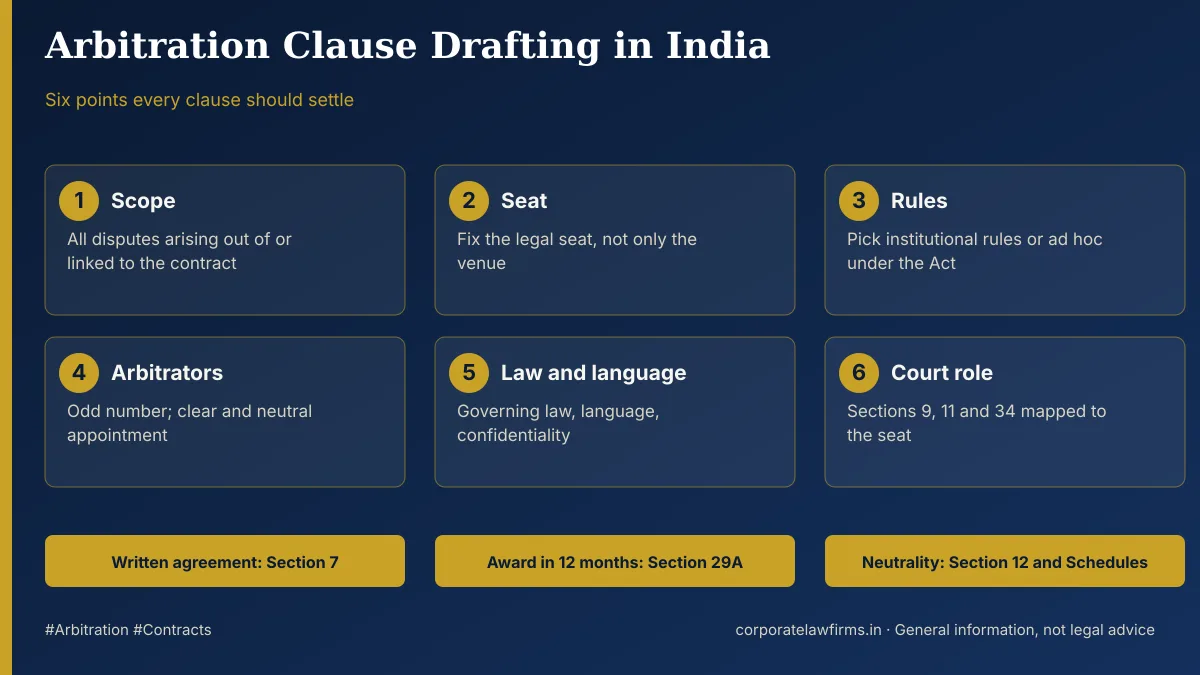
Arbitration clause drafting in India decides how a future dispute will be heard, where, and by whom. A weak clause can lead to months of court fights before arbitration starts. A clear clause under the Arbitration and Conciliation Act, 1996 (A&C Act) saves cost and time.
Key Takeaways
- The clause must show a clear intention to refer disputes to arbitration. Section 7 needs the agreement to be in writing.
- Fix the seat, not only the venue.
- Choose institutional rules or ad hoc rules, and say so plainly.
- Provide the number of arbitrators and how they are appointed.
- Name the governing law of the contract and the language of the proceedings.
- Check the current Act and rules on India Code.
What is an arbitration clause?
An arbitration clause is a term in a contract where parties agree to refer present or future disputes to an arbitral tribunal, and not to a court. It is the base of the process. If it is defective, the award itself can be challenged.
The clause can be part of the main contract, or a separate agreement. Under Section 7, the arbitration agreement must be in writing. It may be in an exchange of letters, emails or other records. Read our overview on arbitration legal services for the broader process.
What are the essential elements of an arbitration clause?
| Element | What to state |
|---|---|
| Scope | “All disputes arising out of or in connection with this contract” |
| Seat | The legal place, such as Chennai or Mumbai |
| Venue | Where hearings may be held, if different |
| Rules | Institution rules or ad hoc under the A&C Act |
| Tribunal | Number of arbitrators and the method of appointment |
| Language | Language of proceedings and award |
| Governing law | Law of the contract, and of the arbitration agreement if different |
| Costs and confidentiality | Sharing of costs and secrecy of proceedings |
Seat vs venue: why does it matter?
The seat fixes which courts have supervisory power for applications such as Section 9 (interim relief), Section 11 (appointment) and Section 34 (setting aside the award). The venue is the place of hearings. When a clause names one place and calls it only the “venue”, courts look at the whole clause and the conduct of parties to find the seat.
To avoid doubt, write: “The seat of arbitration shall be Chennai.” If hearings may be held online or in another city, add: “Hearings may be held at any other place by agreement or by direction of the tribunal.”
For international contracts, the seat also decides whether Part I of the A&C Act applies. Take care with foreign seat clauses, since enforcement rules differ.
Should you choose institutional or ad hoc arbitration?
Institutional arbitration means a body such as the Mumbai Centre for International Arbitration (MCIA), the Delhi International Arbitration Centre (DIAC), the Indian Council of Arbitration, the Singapore International Arbitration Centre (SIAC), the International Chamber of Commerce (ICC) or the London Court of International Arbitration (LCIA) administers the case under its rules.
Benefits include fixed timelines, fee schedules, emergency arbitrator options and a ready appointing authority. Ad hoc arbitration gives freedom but needs cooperation. If you choose ad hoc, state which procedure applies and who appoints. Read more about the tribunal process in Arbitration Excellence.
How many arbitrators should the clause provide?
Section 10 lets parties decide the number, which should not be even. If they agree on an even number, the Act provides that the tribunal appoints one more arbitrator.
A sole arbitrator is quicker and cheaper. Three arbitrators suit high value cases or technical cases. Many clauses say each party appoints one arbitrator, and the two choose the presiding arbitrator.
Remember the neutrality rules. Section 12 and the Fifth and Seventh Schedules list grounds for doubt about independence. A person with a direct link to a party can be ineligible. So avoid clauses that let one party alone appoint the sole arbitrator.
What other terms should be in the clause?
- Time limit. Section 29A requires an award within 12 months from the date the pleadings are complete, extendable by six months by consent, and then by the court. Fast track options also exist under Section 29B.
- Interim relief. Parties can approach a court under Section 9, and the tribunal after it is formed.
- Emergency arbitrator. Useful where institutional rules allow it.
- Confidentiality. Section 42A provides confidentiality, and the clause can add detail.
- Costs. State how fees and costs are shared, subject to Section 31A.
- Multi-tier steps. A step of negotiation or mediation before arbitration. See mediation law. Keep the steps short and clear, or the clause itself will be disputed.
Sample arbitration clause
This is a general model for discussion. Adapt it to your contract.
“Any dispute, difference or claim arising out of or in connection with this Agreement, including its existence, validity, interpretation, performance, breach or termination, shall be referred to and finally resolved by arbitration under the rules of [name of institution], which rules are deemed incorporated by reference. The seat of arbitration shall be [city], India. The tribunal shall consist of [one / three] arbitrator(s). The language of the arbitration shall be English. This Agreement and the arbitration agreement shall be governed by the laws of India. Subject to the above, the courts at [city] shall have exclusive jurisdiction for the purposes of Sections 9 and 34 of the Arbitration and Conciliation Act, 1996.”
Common mistakes to avoid
- Using “may” instead of “shall” refer disputes to arbitration.
- Naming a venue and no seat.
- Giving one party the power to appoint the sole arbitrator.
- Naming an institution that does not exist or has changed its name.
- Copying a clause from a foreign contract without checking Indian law.
- Silent on the number of arbitrators.
- A clause that mixes court jurisdiction and arbitration in a contradictory way.
- Leaving out the language and governing law.
Good clauses sit inside a good contract. See our guide on corporate contracts and commercial law, the hub on Arbitration and ADR and the note on arbitration in property matters.
Laws, rules and institutional rules change. Verify the current text before you sign.
For general information on your matter, you may contact the firm.
This article is general information, not legal advice. Reading it does not create an advocate-client relationship.
Frequently Asked Questions
What is the difference between seat and venue of arbitration?
How many arbitrators should the clause provide?
Is an institutional clause better than an ad hoc clause?
Can a court appoint the arbitrator if the clause is silent?
Topics: ArbitrationContracts
Related reading
This article is general information, not legal advice. Reading it does not create an advocate-client relationship. Read the disclaimer. Official sources: India Code, Bar Council of India.