FEMA Compounding Procedure Before RBI: Step-by-Step Guide
By Adv. Saravvanan R, Advocate · Reviewed by Advocate · Updated · 6 min read · Corporate Advisory & Compliance
Short answer
FEMA compounding is a way to settle a contravention of the Foreign Exchange Management Act, 1999 by paying a sum fixed by the RBI, instead of facing adjudication and penalty under Section 13. The company files an application under the Compounding Rules with the RBI, which passes a compounding order after hearing.
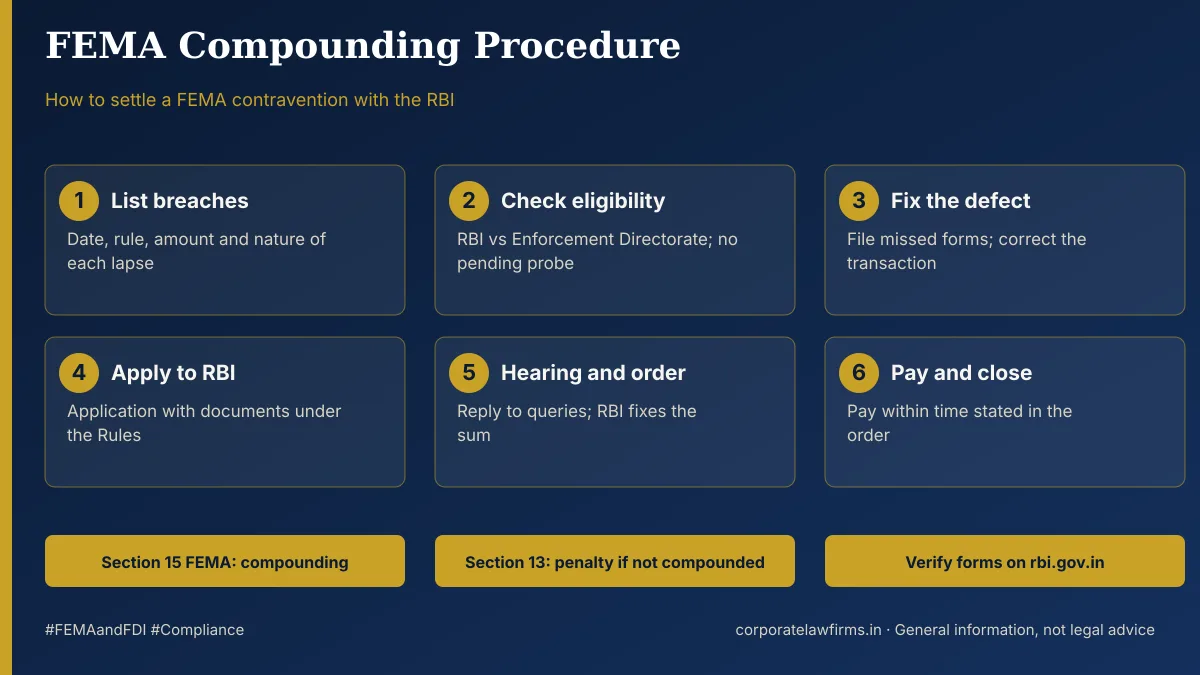
The FEMA compounding procedure lets a person settle a contravention of the Foreign Exchange Management Act, 1999 (FEMA) with the Reserve Bank of India (RBI), on payment of a sum fixed by the RBI. It is faster and less formal than adjudication. It is meant for those who accept the lapse and want to regularise it.
Key Takeaways
- Compounding is a settlement under Section 15 of FEMA. It avoids a full adjudication and penalty under Section 13.
- The RBI deals with most contraventions. Section 3(a) contraventions go to the Directorate of Enforcement.
- The procedure is governed by the Foreign Exchange (Compounding Proceedings) Rules. Check the version currently in force, as the Rules were replaced in 2024.
- You must usually correct the filing or transaction defect and then apply.
- Always verify current forms, portal and directions on the RBI website.
What is FEMA compounding?
Section 15 of FEMA allows any contravention under Section 13 to be compounded, on application, by the person named in the Rules. In simple words, you admit the lapse, the RBI fixes a payment, and once you pay, the case for that lapse closes.
Compounding does not cancel the underlying transaction. You may still need to file missed forms, repatriate funds, or unwind a transaction. For the wider regime, see our guide on the RBI compliance consultant and India’s foreign exchange landscape.
What does Section 13 of FEMA provide?
Section 13 provides that if a person contravenes FEMA or a rule, regulation, notification, direction or order, he is liable to a penalty. Where the sum is quantifiable, the penalty can be up to three times that sum. Where it is not, the Act fixes an upper amount. If the contravention continues, a further daily penalty applies. The Act also has provisions on confiscation in some cases.
Check the exact text on India Code before you assess exposure.
Which contraventions are commonly compounded?
| Area | Examples |
|---|---|
| Foreign direct investment | Late reporting of allotment, wrong pricing, missing filings |
| Overseas investment | Investment without proper approval or reporting |
| External commercial borrowing | Wrong end use, late reporting, wrong lender |
| Export and import | Delay in realisation or repatriation of proceeds |
| Immovable property and others | Acquisition or transfer in breach of rules |
Some lapses, such as late filings, may also be regularised under late submission fee schemes in the regulations. This is not the same as compounding. Check which route applies.
Who handles the application?
The RBI deals with applications for most contraventions. The applicant files with the RBI office that has jurisdiction over the applicant’s registered office or place of business, using the mode the RBI specifies. For businesses in Tamil Nadu, this is usually the Chennai regional office of the Foreign Exchange Department. Verify the current mode and office on the RBI website.
Contraventions linked to Section 3(a) are compounded by the Directorate of Enforcement. A matter that is already under investigation or adjudication should be checked against the Rules before an application is made.
How do you apply? The FEMA compounding procedure step by step
Step 1: List the contraventions
Make a table with the date, rule, amount and nature of each breach. Include the date the breach started and ended.
Step 2: Correct the defect
File pending forms, correct reporting, or bring in or send back funds as needed. The RBI prefers cases where the defect is already fixed or a plan is shown.
Step 3: Prepare the application
Write a clear application and attach supporting documents. State facts only. Explain why the lapse occurred and the steps taken to prevent it again.
Step 4: File and respond to queries
File as per the RBI procedure. Answer queries in time. Delay can add to the processing time.
Step 5: Attend the hearing
The RBI may call for a personal hearing before passing its order. Attend with an authorised person who knows the facts.
Step 6: Pay and close
The compounding order states the amount and the time to pay. Pay within the time and keep the proof. Ask for confirmation that the matter is closed, if the order does not say so.
Documents required
- Copies of the Articles, board resolutions and authority letters.
- Valuation reports, share certificates and transaction agreements.
- Bank advices, FIRC or other foreign inward remittance proofs.
- Forms already filed and acknowledgements, such as FC-GPR or FC-TRS where relevant.
- Auditor’s or company secretary’s certificates.
- Chronology of the contravention with amounts and dates.
- Explanation letter signed by an authorised signatory.
Common mistakes to avoid
- Waiting for a notice instead of acting on a known lapse.
- Applying without correcting the underlying filing.
- Missing a contravention in the list, which then arises later.
- Giving incomplete or inconsistent facts to the RBI.
- Treating compounding as a way to approve a transaction that needed prior approval.
- Not following the payment deadline in the order.
- Ignoring related laws, such as company law filings. Our note on company law compliance is a useful cross-check.
For FDI basics, read our FDI guide. For disputes with the authorities, see foreign exchange litigation. IT exporters can also read our note on compliance for IT and ITES exporters.
Rules, forms and fees change. Verify the current Compounding Rules, Master Direction and portal on the official RBI site before you act.
For general information on your matter, you may contact the firm.
This article is general information, not legal advice. Reading it does not create an advocate-client relationship.
Frequently Asked Questions
What is compounding under FEMA?
Who can compound a FEMA contravention?
What is the penalty if I do not compound?
How long does compounding take?
Topics: FEMA & FDICompliance
Related reading
This article is general information, not legal advice. Reading it does not create an advocate-client relationship. Read the disclaimer. Official sources: India Code, Bar Council of India.