Reply to Customs Show Cause Notice: Steps Under Section 124
By Adv. Saravvanan R, Advocate · Reviewed by Advocate · Updated · 6 min read · Tax & Labour Disputes
Short answer
To reply to a customs show cause notice, read the charges and relied-upon documents, note the reply date, collect proof, and file a written reply that answers each allegation with facts and law. Section 124 of the Customs Act, 1962 requires a notice and a personal hearing before penalty or confiscation.
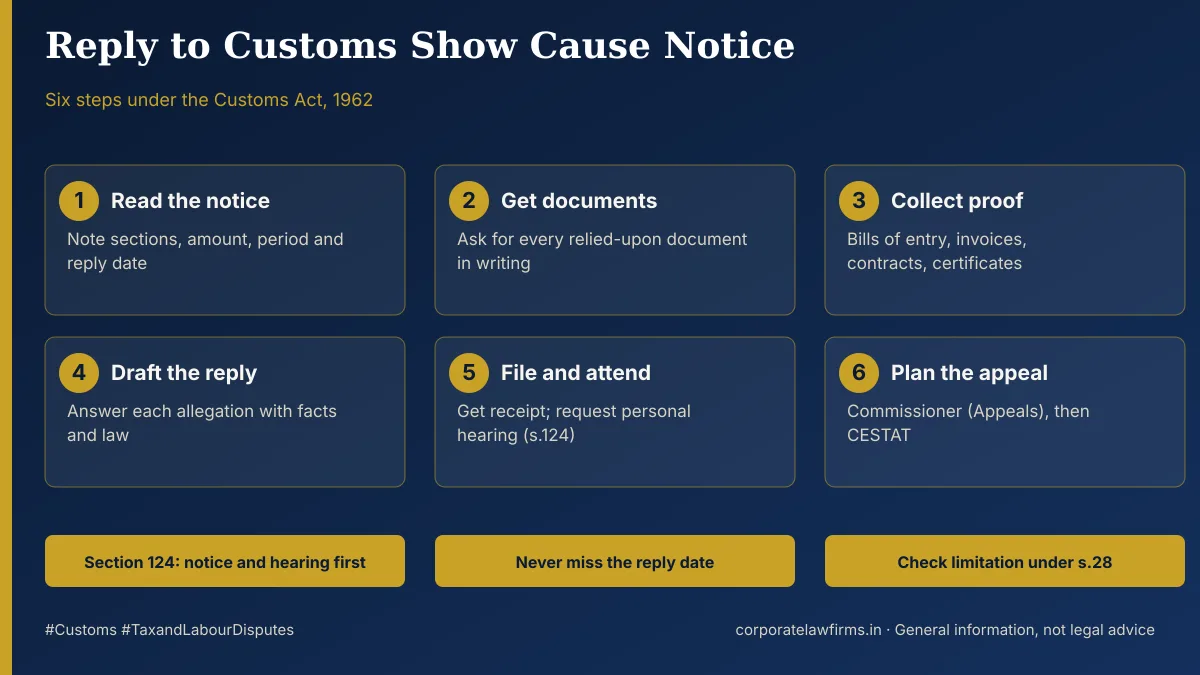
A reply to a customs show cause notice (SCN) is your main chance to put facts and law before the adjudicating officer. Under the Customs Act, 1962, an order that confiscates goods or imposes a penalty cannot be passed without first issuing a notice and giving the person a fair hearing. A careful, on-time reply decides much of what follows.
Key Takeaways
- Section 124 of the Customs Act, 1962 requires a written notice, a chance to represent and a personal hearing before confiscation or penalty.
- Note the reply date and hearing date on day one.
- Ask for all relied-upon documents. You cannot answer what you have not seen.
- Check limitation. A demand notice under Section 28 must be issued within the time the Act allows.
- Keep the right to appeal. Orders can be challenged before the Commissioner (Appeals) and CESTAT.
What is a customs show cause notice?
A show cause notice is a written statement from the department. It lists the alleged violation, the sections of the Act relied on, the duty or penalty proposed and the documents used. It asks you to “show cause” why the proposal should not be confirmed.
Common triggers include wrong tariff classification, undervaluation, wrong exemption claim, misdeclaration of origin and mismatch in import-export documents. A notice may follow an audit, a Special Valuation Branch inquiry or an investigation. Our note on SVB inquiries covers one such route.
What does Section 124 of the Customs Act say?
Section 124 is the fair hearing rule. It says no order confiscating goods or imposing a penalty can be made unless the owner of the goods or the person concerned has been given a notice in writing stating the grounds, a chance to make a representation and, if he wants, a hearing. The notice can be issued with the approval of a senior officer, and the Act sets the form of the process.
Demand of duty not paid or short paid usually arises under Section 28. Time limits differ for ordinary cases and for cases of fraud, collusion or wilful misstatement. Read the current text on India Code and the CBIC portal.
How should you reply to a customs show cause notice?
Step 1: Read it fully
Write down the sections, the amount, the period covered, the persons named and the dates. Check that the notice is issued by a proper officer and that your name and importer code are correct.
Step 2: Seek documents and time
If any relied-upon document is missing, ask for it in writing. If you need more time, send a short request before the due date, with reasons.
Step 3: Build the reply
Answer each allegation under a separate heading. State facts first and attach proof. Then add legal grounds.
Step 4: File and take a receipt
File the reply as the notice directs, by hand or through the portal, and keep an acknowledgement. Ask for a personal hearing in the reply itself.
What should the reply contain?
| Part | What to include |
|---|---|
| Preliminary objections | Jurisdiction, limitation, defects in the notice |
| Facts | Short, dated account of the import or export |
| Para-wise reply | Answer to each allegation |
| Evidence | Documents, certificates, technical or lab reports |
| Law | Statute, notifications, tribunal and court rulings you are sure of |
| Prayer | Drop the notice, or reduce demand and penalty |
Avoid long speeches. Use short numbered paragraphs.
Documents required
- Copy of the SCN and annexures.
- Bills of entry or shipping bills.
- Invoices, purchase orders, contracts and payment proof.
- Packing list, bill of lading or airway bill.
- Test reports, product catalogues and technical literature.
- Origin and other certificates.
- Statements recorded earlier and your letters to the department.
What happens at the personal hearing?
The adjudicating officer hears you or your authorised representative. Take a short written submission and hand it in. If the department relies on a statement of another person, you may ask for cross-examination, which the Act deals with in a separate provision.
After the hearing, the officer passes a speaking order. It should deal with each point in your reply. For classification disputes, see our guide on challenging tariff classification orders.
How can you appeal an adjudication order?
You can file an appeal before the Commissioner (Appeals) under Section 128 within the period fixed by the Act. A further appeal lies to the Customs, Excise and Service Tax Appellate Tribunal (CESTAT) under Section 129A. A pre-deposit is generally required as a percentage of duty or penalty, as per Section 129E. Check the current percentage and cap before filing.
Further appeals on questions of law can go to the High Court or Supreme Court, as the Act provides.
Common mistakes to avoid
- Ignoring the notice or missing the reply date.
- Replying without checking relied-upon documents.
- Admitting liability in a casual letter before reviewing the facts.
- Skipping limitation and jurisdiction points.
- Filing a copy-paste reply that does not answer the actual allegations.
- Not asking for a hearing.
- Missing the appeal period after an adverse order.
For wider support on import and export disputes, see customs clearance disputes, our hub on Tax, Labour and Regulatory Disputes, and the checklist for replying to GST notices, which shares many principles.
Rules, forms and rates change. Verify the current law on official portals before you act.
For general information on your matter, you may contact the firm.
This article is general information, not legal advice. Reading it does not create an advocate-client relationship.
Frequently Asked Questions
How much time do I get to reply to a customs show cause notice?
Is a personal hearing compulsory?
Can I pay the duty and close the matter?
Where do I appeal against the adjudication order?
Topics: CustomsCompliance
Related reading
This article is general information, not legal advice. Reading it does not create an advocate-client relationship. Read the disclaimer. Official sources: India Code, Bar Council of India.