NCLT Chennai Bench Filing Procedure: Steps and Papers
By Adv. Saravvanan R, Advocate · Reviewed by Advocate · Updated · 6 min read · Business & Commercial Litigation
Short answer
Filing before the NCLT Chennai bench follows the NCLT Rules, 2016 and, for insolvency matters, the IBC application rules. You prepare the petition with the prescribed form, affidavit and documents, file it through the e-filing system or registry, pay the fee, cure registry defects and wait for listing. Verify current rules and forms.
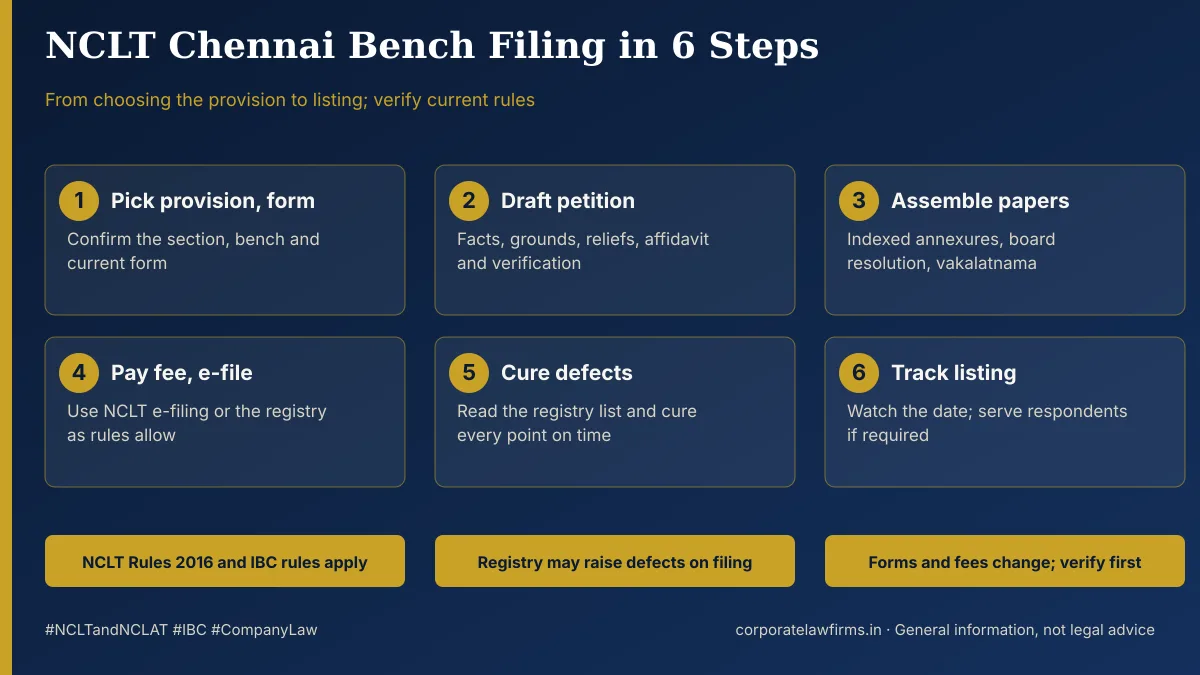
The NCLT Chennai bench filing procedure follows the National Company Law Tribunal Rules, 2016 and, for insolvency matters, the rules made under the Insolvency and Bankruptcy Code, 2016. You prepare a petition in the prescribed form with an affidavit and documents. You file it through the registry or the e-filing system and pay the fee. The registry checks it, and the bench lists it.
Rules, forms, fees and practice directions change from time to time. This article gives the general flow. Verify every point on India Code, the MCA website and the NCLT’s own website.
Key Takeaways
- The NCLT works under the Companies Act, 2013, the NCLT Rules, 2016 and the IBC.
- The Chennai bench is the usual forum for matters linked to its territory. Verify the area.
- Filing needs a prescribed form, affidavit, annexures and fee.
- The registry scrutinises every filing and may raise defects.
- Cure defects quickly. Defective filings may not be listed.
What does the NCLT Chennai bench hear?
The NCLT hears company law matters such as oppression and mismanagement, schemes of arrangement, rectification of registers and revival of struck-off companies. It also hears insolvency applications by creditors and corporate debtors. See Section 7 and Section 9 of the IBC for the main routes.
Appeals lie to the NCLAT. For that stage, read NCLAT and NCLAT SOP 2026.
Which bench should you file before?
Filing is made before the bench that has jurisdiction over the registered office of the company concerned. The Chennai bench is generally understood to serve Tamil Nadu and Puducherry, but confirm the current territorial notification. Filing before the wrong bench causes delay. For IBC matters, the registered office of the corporate debtor is the usual test.
How do you file before the NCLT Chennai bench?
- Identify the correct provision and the right form.
- Draft the petition with facts, grounds and reliefs.
- Prepare the supporting affidavit and verification.
- Index and paginate the annexures.
- Prepare the vakalatnama or authorisation, and a board resolution if a company files.
- Pay the prescribed fee.
- File through the e-filing system or the registry, as the current practice requires.
- Receive the filing number and track the registry’s scrutiny.
- Cure any defects within the time allowed.
- Wait for the listing date and notice.
Some matters may require service of copies on the respondents before or after filing. Check the rules.
What forms are used for IBC applications?
Under the IBC application rules, a financial creditor generally uses Form 1 for an application under Section 7. An operational creditor uses Form 5 for Section 9, after a demand notice. A corporate applicant uses Form 6 for Section 10. Forms and annexure requirements are revised from time to time, so verify the current versions before you draft.
For Companies Act matters, the NCLT Rules, 2016 prescribe the forms and the manner of presenting petitions and applications. This article does not list form numbers for these, because they vary with the provision and may change.
What documents are generally needed?
| Document | Purpose |
|---|---|
| Petition or application | States the facts, grounds and relief |
| Affidavit and verification | Supports the facts on oath |
| Annexures | Contracts, invoices, notices, statements |
| Board resolution or authority letter | Shows who can act for a company |
| Vakalatnama | Authorises the advocate |
| Proof of fee payment | Required for acceptance |
| Proof of service, where needed | Shows that notice was given |
How does e-filing work?
The NCLT has an e-filing facility on its website. You usually register, upload the petition and annexures in the required format, pay the fee online and receive an acknowledgement. Whether physical copies must follow depends on the current rules and the bench’s practice directions. Ask the registry. See NCLAT SOP 2026 for an example of how procedure is changing at the appellate level.
What happens after filing?
The registry checks the papers and lists defects. After cure, the matter is numbered and listed before a bench. Notice goes to the respondents. In IBC matters, once an application under Section 7 or 9 is admitted, a moratorium begins. See moratorium under Section 14 IBC for how courts view it.
What are the common mistakes?
- Filing before the wrong bench.
- Using an old form.
- An affidavit that is unsigned, unnotarised or wrongly verified.
- Missing the board resolution.
- Unindexed or illegible annexures.
- Not curing defects on time.
- Skipping the demand notice in a Section 9 case.
- Not checking limitation before filing.
Documents required
- Certificate of incorporation and registered office proof.
- Contracts, invoices, ledgers or loan records.
- Demand notice and proof of delivery, if required.
- Board resolution and authority documents.
- Identity and address proof of the signatories.
- Court fee or filing fee proof.
What should you do next?
First, confirm the provision under which you must file and the bench with jurisdiction. Then confirm the current form, fee and mode of filing. If the matter relates to a struck-off company, see revival of a struck-off company and appeal against a strike-off. For the overview, read insolvency, bankruptcy and debt recovery and navigating NCLT for your business.
Practical tips for the filing day
- Check the defect list on the e-filing record and clear it quickly.
- Keep the index and page numbers of annexures consistent.
- Serve the other side as the Rules require and keep proof of service.
- Note the next date of hearing and the bench number after each listing.
For debt-related petitions, read insolvency under IBC Section 7 and Section 9. For appeals, see the page on the National Company Law Appellate Tribunal.
For general information on your matter, you may contact the firm.
This article is general information, not legal advice. Reading it does not create an advocate-client relationship.
Frequently Asked Questions
Can I file before the NCLT Chennai bench online?
Which law governs NCLT filing?
What are the forms for IBC applications?
What happens if there are defects in my filing?
Topics: NCLT & NCLATIBCCompany Law
Related reading
- IBC Section 7 and Section 9: Insolvency Explained
- NCLAT: Role, Powers and Appeals Under Company Law
- NCLAT SOP 2026: Checklist Before Filing
- NCLT in India: Jurisdiction, Filing Process and Appeals
- Section 14 IBC Moratorium Bars Section 138 Cases: SC
- Revival of a Struck Off Company: Process and Limits
- Appeal Against a Private Limited Company Strike Off
This article is general information, not legal advice. Reading it does not create an advocate-client relationship. Read the disclaimer. Official sources: India Code, Bar Council of India.