Cheque Bounce Section 138 Notice: Time Limits and Steps
By Adv. Saravvanan R, Advocate · Reviewed by Advocate · Updated · 6 min read · Business & Commercial Litigation
Short answer
For a cheque bounce under Section 138 of the Negotiable Instruments Act, 1881, the payee must send a written demand notice within 30 days of the bank return memo. The drawer then has 15 days from receipt to pay. If unpaid, a criminal complaint must be filed within one month after those 15 days end.
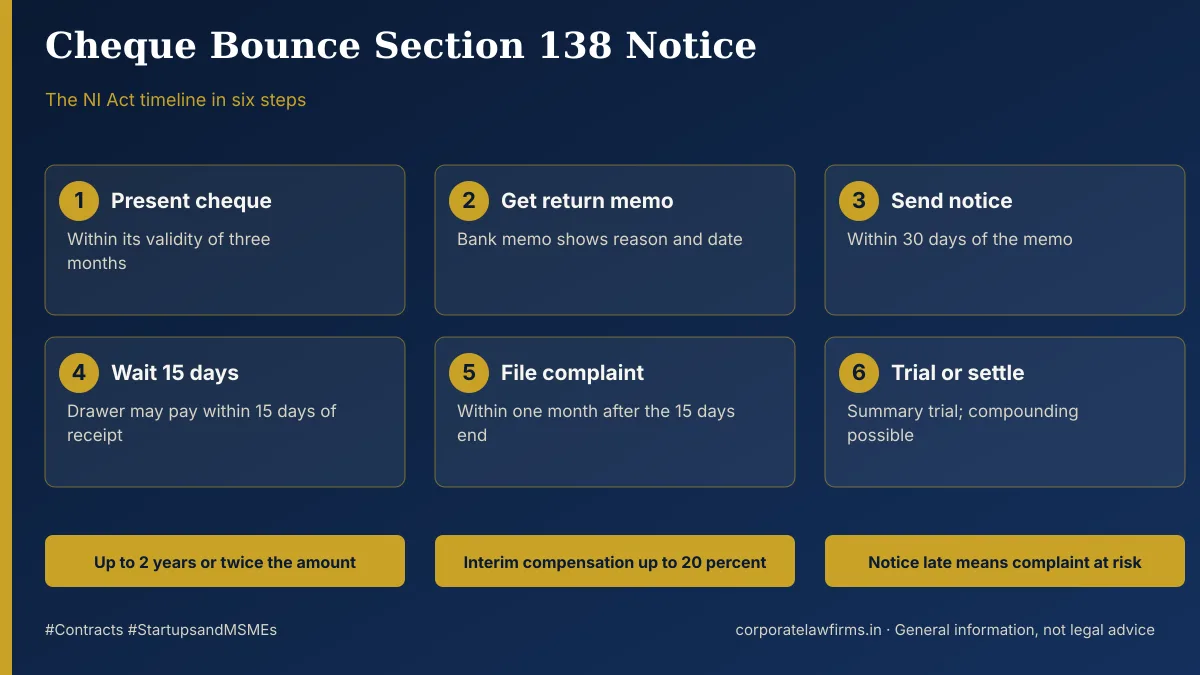
A cheque bounce Section 138 notice is the first formal step when a cheque is returned unpaid for insufficient funds or because the amount exceeds the arrangement with the bank. The Negotiable Instruments Act, 1881 (NI Act) sets strict time limits. If you miss one, the criminal complaint can fail. This guide explains the steps in order.
Key Takeaways
- The demand notice must be sent within 30 days of the bank return memo.
- The drawer gets 15 days from receipt of the notice to pay.
- The complaint must be filed within one month after the 15 days end.
- The cheque must have been presented to the bank within its validity period, which is three months from its date.
- Keep every paper: cheque, memo, notice, postal proof and the underlying contract.
When does Section 138 of the NI Act apply?
Section 138 applies when a cheque is issued for the discharge, wholly or partly, of a legally enforceable debt or other liability, and the bank returns it unpaid. The reason can be insufficient funds, or that the amount exceeds the arrangement made with the bank. Other reasons such as “account closed” are also commonly treated as covered by the section, based on court rulings.
The cheque must be presented within three months from its date, or within its validity period, whichever is earlier. A gift or a cheque not backed by a debt does not attract the section. You can read the Act on India Code.
What is the timeline under Section 138 and Section 142?
| Step | Time limit | Source |
|---|---|---|
| Present cheque to bank | Within validity (three months) | Section 138 |
| Send demand notice | Within 30 days of the return memo | Section 138(b) |
| Drawer pays | 15 days from receipt of notice | Section 138(c) |
| File complaint | Within one month after the 15 days end | Section 142(1)(b) |
The court can take cognizance of a late complaint if the complainant shows sufficient cause for the delay. Do not plan around this.
How do you send a valid demand notice?
The notice must be in writing, must be addressed to the drawer and must demand payment of the cheque amount. Mention the cheque number, date, amount, bank, date of presentation, date and reason of return.
Send it by registered post or speed post, and also by email where the email is known. Keep the postal receipts and tracking proof. If the drawer is a company, address it to the company and to the directors in charge of its business, as Section 141 makes them liable in certain conditions.
Do not claim extra amounts in the notice that are not part of the cheque, since a wrong demand can raise a dispute. Interest and costs can be stated separately as a claim, and the cheque amount must be clear.
What happens after the 15 days?
If the drawer pays within 15 days of receipt of the notice, the offence is not made out. If not, the cause of action arises and the payee can file a complaint in the court of the Magistrate. Since the 2015 amendment, Section 142(2) fixes jurisdiction at the place where the payee’s account is held, in the case of an account payee cheque deposited in the bank.
Procedure is handled as a summary trial under Section 143, and evidence can be given by affidavit under Section 145. Criminal procedure now follows the Bharatiya Nagarik Suraksha Sanhita (BNSS), 2023, which replaced the CrPC from 1 July 2024.
What are the penalties and interim relief?
The punishment is imprisonment up to two years, or a fine up to twice the cheque amount, or both. Section 143A allows the court to order interim compensation of up to 20 percent of the cheque amount. Section 148 lets the appellate court order the convicted person to deposit a minimum of 20 percent of the fine or compensation during an appeal. Section 147 makes the offence compoundable.
Documents required
- Original cheque and the deposit slip.
- Bank return memo with the reason and date.
- Copy of the demand notice, postal receipts and tracking report.
- Proof of delivery or refusal, and email proof.
- Invoice, agreement, ledger or other proof of the debt.
- Identity and authority documents of the complainant, such as a board resolution for a company.
- Bank statement showing the account details.
Common mistakes to avoid
- Sending the notice after 30 days from the memo.
- Filing the complaint before the 15-day period ends. This makes the complaint premature.
- Filing after the one-month period without a delay application.
- Presenting the cheque after its validity.
- Naming the wrong party, or leaving out the directors where the drawer is a company.
- Filing in a court without territorial jurisdiction.
- Mixing in a claim that is not related to the cheque.
A notice may also be a first step to a wider money claim. For that, see our guide on a legal notice for recovery of money from a company. If the amount is large and the debtor is a company, read how IBC Sections 7 and 9 work, and our hub on Insolvency, Bankruptcy and Debt Recovery.
Can the dispute be settled?
Yes. Courts regularly refer parties to mediation. A settlement can end the case by compounding. See our note on mediation law and, for civil claims, commercial courts. Businesses can reduce such risks by using clear contracts, as set out in our article on commercial transactions.
Rules and procedure change. Verify the current law and your court’s practice on eCourts and India Code.
For general information on your matter, you may contact the firm.
This article is general information, not legal advice. Reading it does not create an advocate-client relationship.
Frequently Asked Questions
Within how many days must I send the Section 138 notice?
How long does the drawer have to pay after the notice?
What is the time limit to file the complaint?
What is the punishment under Section 138?
Topics: ContractsStartups & MSMEs
Related reading
- Legal Notice for Recovery of Money From a Company: Guide
- Insolvency and Debt Recovery in India: Full Guide
- Commercial Courts Act 2015: Disputes and Procedure
- Commercial Transactions Lawyer: Why Businesses Need One
- Mediation Law in India: Process and Court Referral
- IBC Section 7 and Section 9: Insolvency Explained
This article is general information, not legal advice. Reading it does not create an advocate-client relationship. Read the disclaimer. Official sources: India Code, Bar Council of India.