Legal Notice for Recovery of Money From a Company: Guide
By Adv. Saravvanan R, Advocate · Reviewed by Advocate · Updated · 7 min read · Business & Commercial Litigation
Short answer
A legal notice for recovery of money is a written demand sent to a company that owes a debt, stating the amount, the basis, a payment deadline and the steps you will take if unpaid. Money claims generally have a three-year limitation period. Commercial disputes need pre-institution mediation under Section 12A before a suit, unless urgent relief is sought.
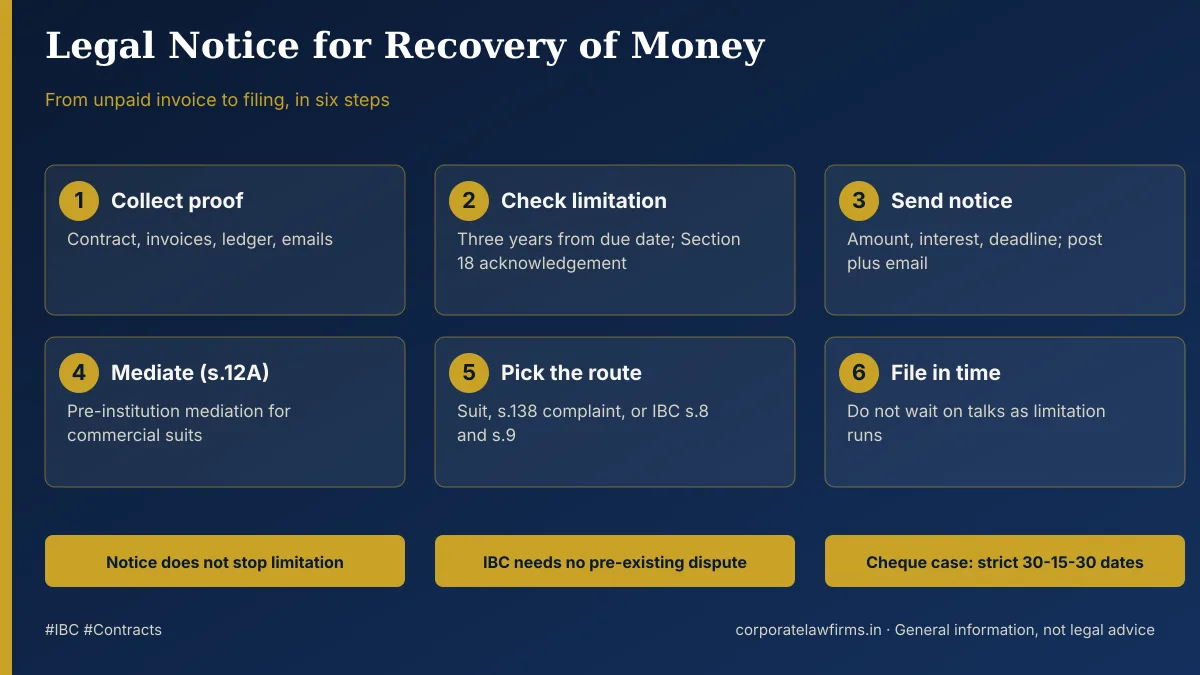
A legal notice for recovery of money is the first formal step when a company does not pay what it owes. It tells the debtor, in writing, what is due, why, and by when it must be paid. It also builds a record that you can use later in court, in mediation or before the NCLT.
Key Takeaways
- The notice states the amount, the basis of the claim, interest and a clear deadline, usually 15 to 30 days.
- The limitation period for most money claims is three years from the date of default.
- Commercial disputes need pre-institution mediation under Section 12A of the Commercial Courts Act, 2015, unless urgent relief is sought.
- Cheque bounce, IBC and summary suits have their own notice and time rules.
- Do not threaten false criminal action. Keep the tone factual.
What is a legal notice for recovery of money?
It is a formal letter, often sent through an advocate, to a company or its directors. It demands payment of a debt arising from goods supplied, services rendered, a loan or a contract. It also states the action you will take if payment is not made.
A notice does not create the right to money. The right comes from the contract and the law. The notice shows that you asked for payment and gives the debtor a last chance to pay or reply.
Is a legal notice mandatory?
Against a private company, no general rule says a notice must be sent before a civil suit. Notices are mandatory in some cases: Section 138 of the Negotiable Instruments Act for a bounced cheque, a demand notice under Section 8 of the IBC for an operational creditor, and some notice terms in the contract itself. Check your contract for a “notice and cure” clause.
Even when optional, a notice is useful. It fixes the date of demand, supports a claim for interest and can lead to a settlement. Our guide on corporate contracts and commercial law shows how payment terms are drafted.
What should the notice contain?
| Part | Content |
|---|---|
| Parties | Full name and address of the company, registered office, and your details |
| Facts | Contract, invoices, dates, goods or services supplied |
| Default | Due date, amount unpaid, part payments received |
| Interest | Rate in the contract, or as the law allows |
| Demand | Exact sum and deadline for payment |
| Consequence | Steps you will take if unpaid |
| Reservation | Right to claim costs and other remedies |
Keep it short, factual and polite. List documents by name. Do not use abusive words. Do not threaten criminal action unless there is a real legal basis.
How should the notice be sent?
Send it to the registered office of the company by registered post or speed post. Add courier and email to the official address in your contract. Keep postal receipts, tracking proof and email delivery proof. Also send a copy to the person who signed the contract.
You can check company details on the MCA portal to confirm the registered office and directors.
What is the limitation period for recovery of money?
The Limitation Act, 1963 sets three years for most money claims, counted from the date the amount became due. A written and signed acknowledgement of the liability before the period ends gives a fresh period under Section 18. Part payment can also affect limitation, within the rules of the Act.
Sending a notice does not stop the clock. If time is close to running out, file the suit. For a running account, the date of the last entry and the nature of the account matter, so take care.
What is pre-institution mediation under Section 12A?
The Commercial Courts Act, 2015 covers commercial disputes of specified value. Section 12A requires the plaintiff to try pre-institution mediation before filing such a suit, unless the suit contemplates urgent interim relief. The mediation is done through the Legal Services Authority under the Rules, within a limited period which can be extended.
If mediation fails, you get a non-starter or failure report and file it with the plaint. A suit filed without it may be rejected. Read about commercial courts and mediation law. Verify the specified value and Rules on India Code.
What are the options after the notice?
Civil suit and summary suit
A commercial suit lies in the commercial court. For debts based on a written contract, bill or similar paper, a summary suit under Order XXXVII of the Code of Civil Procedure may be faster, since the defendant must get leave to defend.
Cheque dishonour
If a cheque for the debt bounced, Section 138 of the NI Act offers a criminal route with strict dates. See our guide on cheque bounce Section 138 notice.
IBC route
An operational creditor can issue a demand notice under Section 8 of the Insolvency and Bankruptcy Code, 2016. If the company does not pay or point to a dispute within 10 days, the creditor can file under Section 9 before the NCLT, if the default meets the minimum threshold set by the Government. A genuine dispute that existed before the notice stops this route, and the Code is not meant to be a pressure tool. See IBC Sections 7 and 9.
MSME dues
A micro or small enterprise supplier can claim interest and approach the Micro and Small Enterprises Facilitation Council under the MSMED Act, 2006, if it is registered and the conditions are met.
Documents required
- Contract, purchase order or quotation.
- Invoices, delivery challans and proof of receipt.
- Ledger statement and confirmation of balances.
- Emails and messages admitting the debt.
- Cheque and return memo, if any.
- Company details from the MCA records.
- Proof of dispatch of the notice.
Common mistakes to avoid
- Waiting too long and letting limitation expire.
- Sending to a wrong or old address.
- Claiming an inflated or vague amount.
- Ignoring the contract clause on notice, dispute resolution or arbitration.
- Skipping Section 12A mediation in a commercial suit.
- Using the IBC notice when the company has a real dispute.
- Threatening a criminal case without grounds.
For wider recovery paths, read our hub on Insolvency, Bankruptcy and Debt Recovery and the note on DRT debt recovery for banks and financial institutions.
Rules and thresholds change. Verify the current law on official portals before you act.
For general information on your matter, you may contact the firm.
This article is general information, not legal advice. Reading it does not create an advocate-client relationship.
Frequently Asked Questions
Is a legal notice compulsory before filing a money suit?
What is the limitation period to recover money?
What is pre-institution mediation under Section 12A?
Can I start insolvency against a company for an unpaid invoice?
Topics: IBCContractsStartups & MSMEs
Related reading
- Cheque Bounce Section 138 Notice: Time Limits and Steps
- IBC Section 7 and Section 9: Insolvency Explained
- Insolvency and Debt Recovery in India: Full Guide
- Commercial Courts Act 2015: Disputes and Procedure
- Mediation Law in India: Process and Court Referral
- Corporate Contracts and Commercial Law in India
- DRT Debt Recovery: How Debt Recovery Tribunals Work
This article is general information, not legal advice. Reading it does not create an advocate-client relationship. Read the disclaimer. Official sources: India Code, Bar Council of India.