IT Act vs DPDP Act: 7 Key Differences for Businesses
By Adv. Saravvanan R, Advocate · Reviewed by Advocate · Updated · 6 min read · Cyber Law
Short answer
The Information Technology Act, 2000 is a broad cyber law covering electronic records, cyber offences and intermediaries, with limited data rules under Section 43A. The Digital Personal Data Protection Act, 2023 is a dedicated privacy law that governs consent, notice, data principal rights, fiduciary duties and heavy penalties for digital personal data.
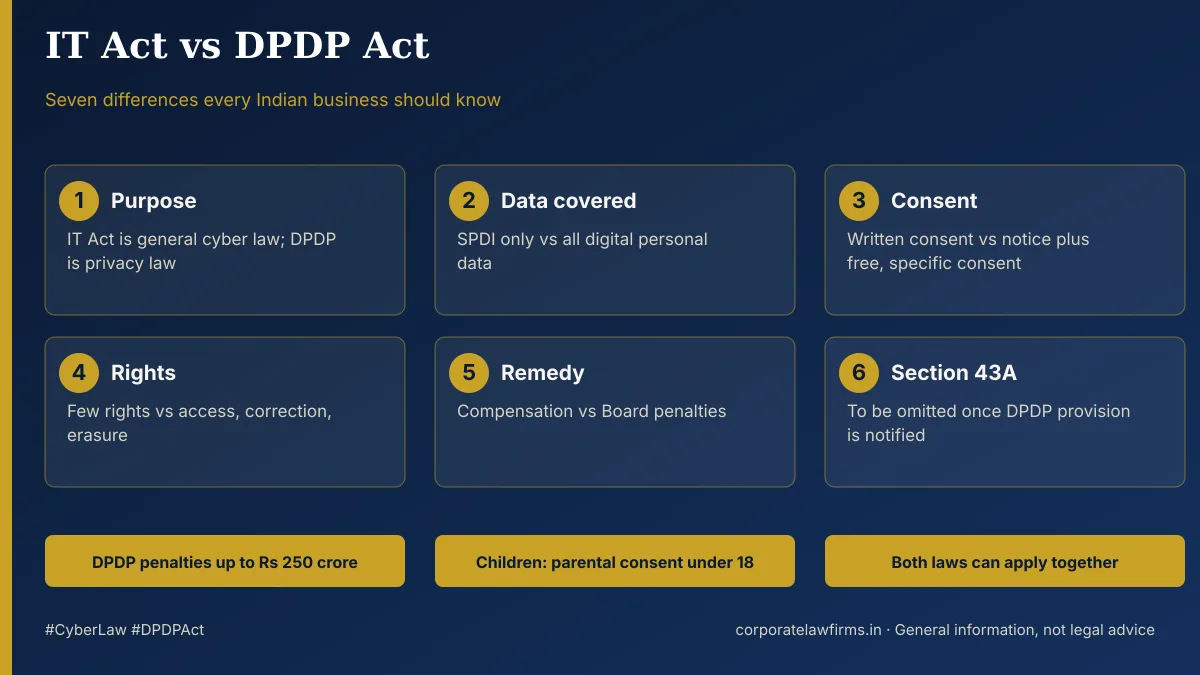
IT Act vs DPDP Act is a common question for Indian businesses that hold customer or employee data. The short position is this: the Information Technology Act, 2000 (IT Act) is a general cyber law, and the Digital Personal Data Protection Act, 2023 (DPDP Act) is a focused privacy law. Both can apply to the same company at the same time.
Key Takeaways
- The IT Act covers e-records, digital signatures, cyber crime and intermediaries. The DPDP Act covers only digital personal data.
- The IT Act has a thin data-protection layer in Section 43A and the SPDI Rules, 2011. The DPDP Act replaces that layer with a full framework.
- The DPDP Act is built on notice, consent, purpose limits, data principal rights and fiduciary duties.
- Penalties under the DPDP Act are much higher than the compensation model under the IT Act.
- Many provisions come into force in phases. Check the current status of the DPDP Rules on MeitY before you plan.
What is the Information Technology Act, 2000?
The IT Act gives legal recognition to electronic records and digital signatures. It also defines cyber offences such as hacking, identity theft and publishing obscene material. It sets rules for intermediaries such as platforms and hosting services.
On data, the IT Act is limited. Section 43A makes a company liable to pay compensation if it is negligent in protecting sensitive personal data. Section 72A punishes disclosure of personal information in breach of a lawful contract. The Reasonable Security Practices and Procedures and Sensitive Personal Data or Information Rules, 2011 (SPDI Rules) add basic consent and privacy policy duties.
You can read the Act on India Code. For the wider picture, see our Cyber Law and Data Protection guide.
What is the DPDP Act, 2023?
The DPDP Act is India’s first dedicated law on digital personal data. It applies to personal data collected in digital form, or collected offline and then digitised. It also applies outside India if a business offers goods or services to people in India.
The Act uses clear roles. The person whose data is used is the Data Principal. The business that decides why and how data is used is the Data Fiduciary. A service provider acting for the fiduciary is a Data Processor. Large or risky fiduciaries can be notified as Significant Data Fiduciaries with extra duties.
A Data Protection Board of India handles complaints and imposes penalties.
IT Act vs DPDP Act: what are the main differences?
| Point | IT Act, 2000 | DPDP Act, 2023 |
|---|---|---|
| Purpose | General cyber law | Personal data protection |
| Data covered | Sensitive personal data (SPDI Rules) | All digital personal data |
| Consent | Written consent for sensitive data | Free, specific, informed consent with notice |
| Individual rights | Few | Access, correction, erasure, grievance, nominee |
| Children | No special rule | Verifiable parental consent for under 18 |
| Remedy | Compensation, adjudicating officer | Penalties after Board inquiry |
| Maximum money exposure | Compensation model | Up to Rs 250 crore under the Schedule |
| Cross-border | No specific rule | Section 16 allows restriction by notified list |
How do consent and notice differ?
Under the SPDI Rules, a company must get written consent before collecting sensitive data such as passwords, health records or financial details. It must also publish a privacy policy.
Under the DPDP Act, every request for consent must come with a notice. The notice must state what data is taken, why, how to withdraw consent and how to complain to the Board. Consent must be as easy to withdraw as to give. There are limited “legitimate uses” where consent is not needed, such as certain State functions, legal duties and medical emergencies.
What duties do businesses have under the DPDP Act?
A Data Fiduciary must use data only for the stated purpose. It must keep data accurate, take reasonable security safeguards and erase data when the purpose ends, unless law requires retention. It must report personal data breaches to the Board and to affected persons.
A fiduciary must also set up a grievance process. Data Principals can ask to see, correct or erase their data. Significant Data Fiduciaries must appoint a Data Protection Officer in India, an independent auditor and carry out impact assessments.
Our note on DPDP and cross-border data transfers covers the transfer rule.
What happens to Section 43A of the IT Act?
The DPDP Act, in its amending section, omits Section 43A of the IT Act once that provision is notified. The SPDI Rules depend on Section 43A, so they are expected to fall with it. Until the date is notified, companies should not drop their current SPDI compliance.
Other parts of the IT Act stay in force. Hacking offences, data theft, intermediary due diligence and blocking powers continue. Read our guide on data privacy and cybersecurity law for those areas.
How do penalties and enforcement compare?
The IT Act relies on an adjudicating officer who awards compensation, plus criminal penalties for specific offences. There was little structured enforcement of data protection.
The DPDP Act gives the Data Protection Board power to inquire into breaches and impose financial penalties listed in its Schedule. The Board can also direct urgent remedial steps. Appeals from the Board lie to the Telecom Disputes Settlement and Appellate Tribunal (TDSAT). A voluntary undertaking by the fiduciary can close a matter in some cases.
Documents and records to prepare
- Data map showing what personal data you hold and where it flows.
- Updated privacy notice and consent forms.
- Contracts with data processors, with security and breach clauses.
- Breach response plan and log.
- Retention and erasure schedule.
- Grievance officer details and a rights request process.
Common mistakes to avoid
- Assuming the DPDP Act repeals the whole IT Act. It does not.
- Treating the privacy policy as a one-time web page, and not as a notice linked to each consent.
- Keeping data for ever “just in case”.
- Leaving processors without written security terms.
- Ignoring children’s data, including sign-ups by minors on apps.
- Waiting for the final date. Start the gap analysis now. See our IT compliance guide for startups and the note for tech firms.
How should a business prepare?
First, list your data and your purposes. Second, replace old consent text with DPDP-style notices. Third, review vendor contracts. Fourth, set up a breach plan. Fifth, train staff who handle customer data, such as marketing teams; our note on digital marketing agencies is useful here.
Rules and notifications change. Check MeitY and India Code for the current text and commencement dates before relying on any provision.
For general information on your matter, you may contact the firm.
This article is general information, not legal advice. Reading it does not create an advocate-client relationship.
Frequently Asked Questions
Does the DPDP Act replace the IT Act?
Which law applies to my company's customer data?
What is the penalty under the DPDP Act?
Is consent needed under the IT Act?
Topics: Cyber & Data ProtectionCompliance
Related reading
This article is general information, not legal advice. Reading it does not create an advocate-client relationship. Read the disclaimer. Official sources: India Code, Bar Council of India.