DPDP Act Cross-Border Data Transfer: Section 16 Guide
By Adv. Saravvanan R, Advocate · Reviewed by Advocate · Updated · 6 min read · Cyber Law
Short answer
Under Section 16 of the DPDP Act, 2023, personal data may be transferred outside India for processing, except to countries the Central Government restricts by notification. This is a negative-list approach. Stricter sector laws, such as RBI rules, still apply. Check the current notifications and Rules on meity.gov.in.
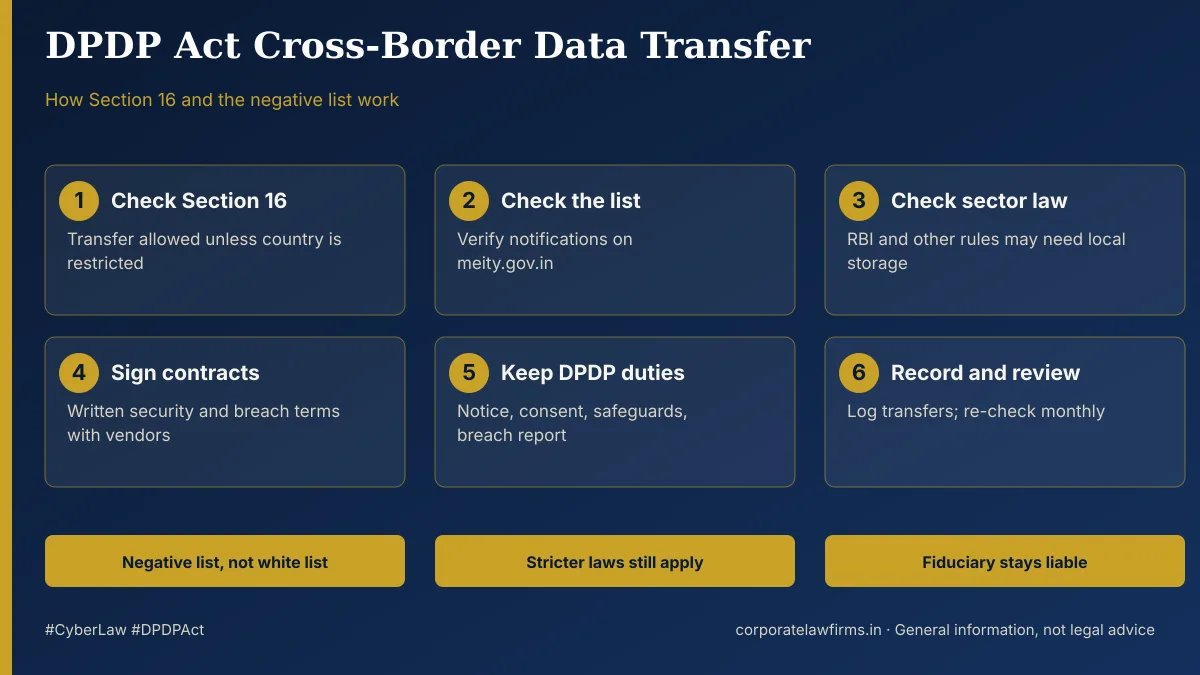
The DPDP Act cross-border data transfer rule is in Section 16 of the Digital Personal Data Protection Act, 2023. The rule is simple on its face. Personal data can go outside India, unless the Central Government has restricted the destination by notification. In practice, you must also check sector laws, contracts and the current DPDP Rules.
Key Takeaways
- Section 16 follows a negative-list approach. Transfers are allowed unless a country is restricted.
- Stricter existing laws, such as sector data-storage rules, continue to apply.
- The Data Fiduciary stays accountable for data sent to overseas vendors.
- The status of the Rules and any restricted-country notification must be verified on meity.gov.in.
- Contracts, security measures and a transfer record are the practical tools.
What does Section 16 of the DPDP Act say?
Section 16(1) lets the Central Government, by notification, restrict the transfer of personal data by a Data Fiduciary for processing to such country or territory outside India as it notifies. That means everything else is open by default.
Section 16(2) adds that nothing in this section limits any existing law which provides a higher degree of protection for personal data or a restriction on its transfer. So the DPDP Act is a floor, not a ceiling.
Read the Act on India Code.
What is the negative-list approach?
Earlier drafts of the data protection law had a “white list” model, where transfers were allowed only to approved countries. The Act as passed uses the reverse. All countries are allowed, except those on a restricted list.
The change helps cloud use, offshore support centres and global group companies. It also brings some uncertainty. A country can be added later, and a business may need to change vendors or hosting at short notice.
Which laws can still restrict cross-border transfer?
| Source | What it may require |
|---|---|
| RBI directions on storage of payment system data | Payment data to be stored only in India (copy abroad allowed for foreign leg, as per the directions) |
| Sector regulators for insurance, telecom, securities | Local storage or approvals for certain records |
| Company law and tax record rules | Books of account to be kept in India, with limited exceptions |
| Government contracts | Data location terms in the tender or contract |
| Future DPDP Rules | May add conditions for transfer |
Always read the exact current text. Sector directions change, and our article on data privacy and cybersecurity law gives wider background. For payment and foreign exchange angles, see the RBI compliance guide.
How does this differ from the IT Act position?
The IT Act, 2000 and the SPDI Rules, 2011 did have a transfer rule. Rule 7 allowed transfer of sensitive data to another body corporate only if it ensured the same level of protection and the transfer was needed to perform a lawful contract or had consent. The DPDP Act drops this test for a simpler list model. For a full comparison, read IT Act vs DPDP Act.
What must a Data Fiduciary still do when sending data abroad?
Section 16 only deals with where data may go. All other duties continue.
- Give notice and take valid consent, or rely on a legitimate use.
- Use data only for the stated purpose.
- Take reasonable security safeguards, also at the overseas vendor.
- Report a personal data breach to the Board and the affected persons.
- Erase data when the purpose ends.
- Respond to rights requests, even if data sits abroad.
A Significant Data Fiduciary may have extra duties. The Rules may also say more on how Data Principals are told about transfers. Check the current Rules.
What is the position on the DPDP Rules and notifications?
The DPDP Act was passed in August 2023. Rules were needed to bring many parts into force, and commencement has been in phases. The Rules and any list of restricted countries must be verified on meity.gov.in and in the Gazette. This article does not assume a particular date or list.
If no country has been notified at the time you read this, transfers are allowed in general. That position can change by a single notification.
Documents required for a transfer review
- Data map showing which personal data goes abroad, to whom and why.
- Vendor and group company contracts with data protection clauses.
- Security certificates or audit reports from the overseas party.
- Consent and notice records.
- Sector licence conditions that affect data location.
- Breach response plan covering offshore systems.
Common mistakes to avoid
- Assuming that “negative list” means no checks are needed.
- Forgetting RBI or other sector rules on local storage.
- Using overseas cloud or SaaS tools without a written processor contract.
- Not tracking where backups and support staff access data from.
- Treating employee data as outside the Act. Employee data in digital form is also personal data.
- Failing to monitor notifications. Set a monthly check of official sites. Our guide for IT and ITES exporters and the note on tech firms show how this works for service businesses.
How should a business plan its transfers?
Start with the data map. Group transfers as intra-group, vendor and customer-directed. For each group, check the sector rule, the contract and the destination country. Keep a short written record of the review. Add a clause that lets you move data quickly if a country is later restricted.
Startups can find a wider checklist in our guide on IT compliance and data privacy for startups. The topic hub is Cyber Law and Data Protection.
For general information on your matter, you may contact the firm.
This article is general information, not legal advice. Reading it does not create an advocate-client relationship.
Frequently Asked Questions
Can Indian companies send personal data abroad under the DPDP Act?
Is there a list of banned countries?
Does data localisation still apply?
Who is liable if an overseas vendor leaks data?
Topics: Cyber & Data ProtectionCompliance
Related reading
This article is general information, not legal advice. Reading it does not create an advocate-client relationship. Read the disclaimer. Official sources: India Code, Bar Council of India.