Corporate Law Internship in Chennai: A Student Guide
By Adv. Saravvanan R, Advocate · Reviewed by Advocate · Updated · 6 min read · Corporate Advisory & Compliance
Short answer
A corporate law internship in Chennai gives law students supervised exposure to company law, contracts, ROC and regulatory compliance, due diligence and tribunal work. To prepare, learn the basics of the Companies Act, 2013, practise legal writing and research, follow your university's internship rules and apply politely with a short CV and cover note.
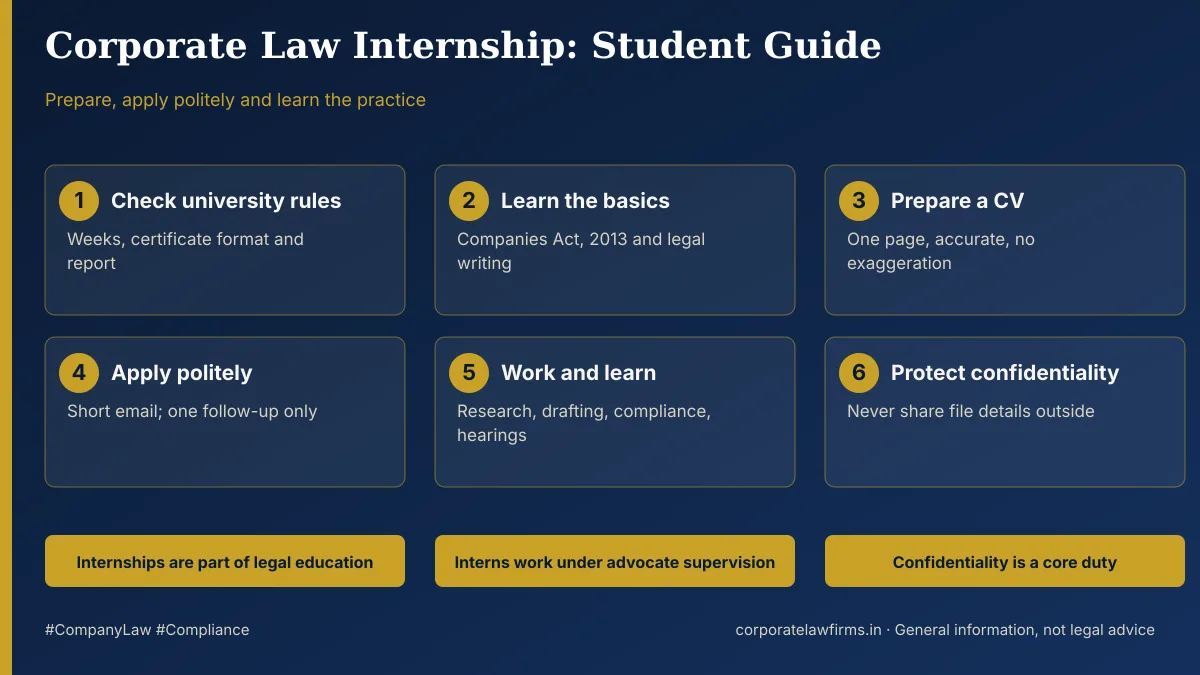
A corporate law internship in Chennai is a short period of supervised learning for law students in the practice of company and commercial law. Interns see how advocates handle company law compliance, contracts, due diligence and tribunal matters. This guide is general information for students on what to expect, how to prepare and how to apply with good etiquette. It is not an invitation to apply to any firm.
Key Takeaways
- Internships are part of legal education under the Bar Council of India rules. Your university sets the details.
- Corporate interns mostly do research, drafting support, compliance tracking and file work.
- Preparation in the Companies Act, 2013 and legal writing makes an internship far more useful.
- Application etiquette matters: be brief, polite and accurate.
- Confidentiality is a basic professional duty, even for interns.
What does a corporate law internship involve?
Corporate law covers the legal life of a company: incorporation, governance, contracts, funding, restructuring and disputes. An intern sees a small part of this under the guidance of an advocate.
Work usually falls into these groups.
| Area | Typical intern tasks |
|---|---|
| Company law and ROC | Track filings, prepare notes on forms, read MoA and AoA |
| Governance | Draft notices and minutes under supervision |
| Contracts | Review clauses, prepare comparison tables |
| Due diligence | Prepare checklists and summarise documents |
| Litigation and tribunals | Prepare case notes, assist with paper books, observe hearings |
| Research | Read statutes, rules and judgments and summarise them |
For a sense of the compliance subject matter, read Corporate Governance and Compliance and the annual compliance calendar for private limited companies.
What do interns learn in a corporate law internship?
Legal research
You learn to find the correct provision, read it carefully and note its limits. You learn to check that a rule is current, because amendments are frequent. Official sources such as India Code and the MCA site are the starting points.
Drafting and review
You learn how a notice, resolution or agreement is built. Good habits include using plain words, defining terms once and checking dates and names.
Compliance practice
You see how deadlines, forms and records work in practice. Examples are board meetings, annual returns and statutory registers. See Board Meetings and Resolutions.
Tribunal and court exposure
If the office handles tribunal work, you may see how matters are prepared for the NCLT. A related guide is NCLT Chennai Bench Filing Procedure.
Professional conduct
You learn confidentiality, punctuality, respect for time limits and honest work. These matter more than any single task.
How to prepare for a corporate law internship
- Read the basics of the Companies Act, 2013: incorporation, directors, meetings, filings.
- Know the types of companies and the difference between a company, an LLP and a partnership. See Company vs LLP vs Partnership.
- Practise short legal notes: facts, issue, law, conclusion.
- Learn to use legal databases and official portals.
- Improve Excel and Word skills, since tracking and formatting are common tasks.
- Revise your university’s internship rules and the format of the certificate.
A simple way to start is to read how a company is formed. See Company Incorporation Procedure under the Companies Act 2013.
What are the BCI and university norms for internships?
The Bar Council of India’s rules of legal education require practical training during the law degree. Universities and law schools turn this into a minimum number of weeks of internships, often with a fixed format for certificates and reports. The details differ between universities and between degree programmes.
Check your own university’s rules for the number of weeks, the type of institutions accepted, the certificate format and the report you must submit. Also check whether any internship must be under an advocate with a particular enrolment status. Rules change, so verify on your university’s website and the Bar Council of India site.
How to apply for a law internship with proper etiquette
- Prepare a one-page CV with your university, year, interests and any research or moot experience.
- Write a short cover note of four or five lines. State your period of availability and the reason for your interest.
- Address the email to a named person or to the office’s general contact, if listed.
- Attach only what is asked for.
- Follow up once after a reasonable time, not daily.
- Accept a refusal or silence politely. Offices have limited capacity.
Do not send the same email to hundreds of offices. Do not exaggerate your skills. Do not ask for a stipend in the first message. This article does not invite applications and does not promise any placement.
Documents students usually need
- Updated CV
- Letter or format required by the university
- Identity and college card
- Writing sample, if asked for
- Internship certificate format of the university
Common mistakes
- Treating the internship as only a certificate exercise.
- Not reading the basics before starting.
- Sharing confidential file details on social media.
- Missing deadlines on small tasks.
- Copying text from the internet into notes without checking the law.
- Not asking for feedback at the end.
- Ignoring the university’s reporting format until the last day.
How to get the most from the internship
Keep a short daily log of what you did and learned. Ask for clarity when you do not understand a task. Show your work in a neat, organised way. At the end, ask for feedback and for the certificate in the format the university requires.
Respect confidentiality. Do not discuss client matters outside the office. Remember that the Advocates Act, 1961 and the Bar Council rules apply to the profession you are entering. For the practical side of choosing and working with an advocate, see How to find a good Lawyer in Chennai?.
For general information on your matter, you may contact the firm.
This article is general information, not legal advice. Reading it does not create an advocate-client relationship.
Frequently Asked Questions
Is an internship compulsory for law students in India?
What do corporate law interns usually do?
How should a student apply for an internship?
Is an internship paid?
Topics: Company LawCompliance
Related reading
- Corporate Governance and Compliance in India: Guide
- Annual Compliance Calendar for Private Limited Companies
- Board Meetings and Resolutions: Legal Requirements
- NCLT Chennai Bench Filing Procedure: Steps and Papers
- How to Find a Good Lawyer in Chennai: Practical Guide
- Company Incorporation Procedure under the Companies Act 2013
This article is general information, not legal advice. Reading it does not create an advocate-client relationship. Read the disclaimer. Official sources: India Code, Bar Council of India.