How Long a CAT Case Takes: Key Factors
By Adv. Saravvanan R, Advocate · Reviewed by Advocate · Updated · 6 min read · Business & Commercial Litigation
Short answer
How long a CAT case takes varies widely. The Administrative Tribunals Act aims at quick disposal, but the real time depends on the bench's workload, how soon respondents reply, interim applications, adjournments and the complexity of the issue. No fixed duration applies. Check the cause list and orders for your own matter.
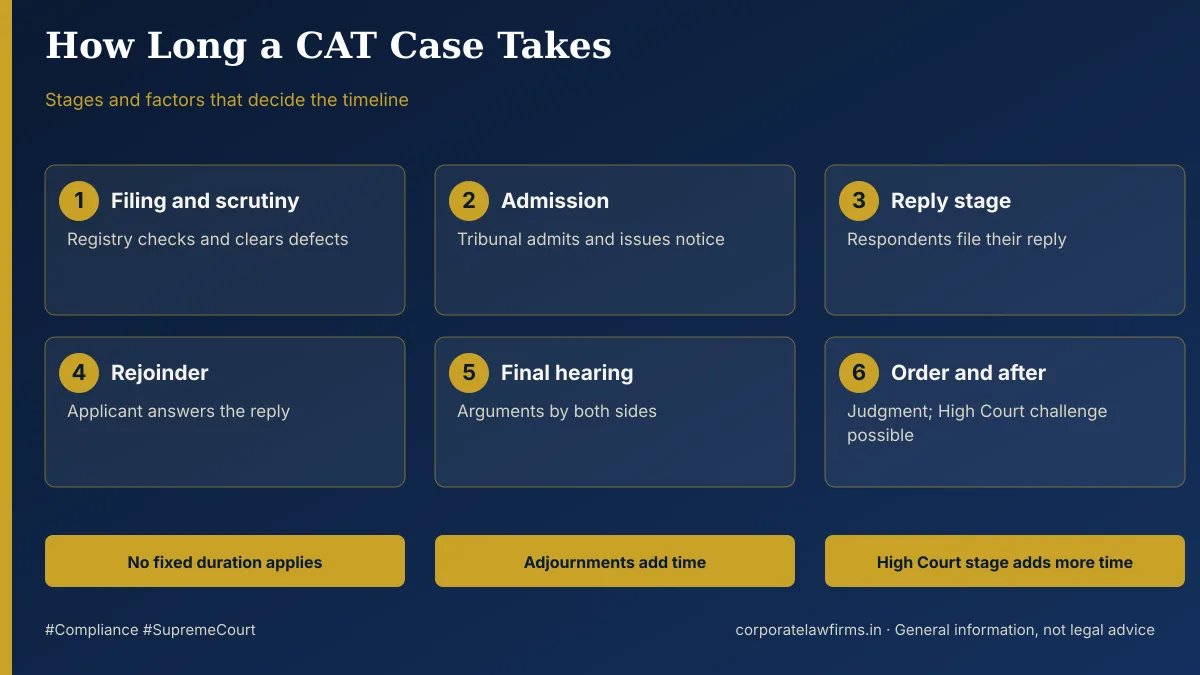
How long a CAT case takes cannot be stated as one number. The Administrative Tribunals Act, 1985 aims at speedy disposal of service disputes, but the actual duration depends on the stages, the bench’s workload and the conduct of both sides. This guide lists the stages and the factors that stretch or shorten the time.
The Central Administrative Tribunal (CAT) deals with recruitment and service conditions of central government employees and certain other covered persons. It was created under Article 323A of the Constitution to give quicker relief than ordinary civil courts.
Key Takeaways
- There is no fixed duration for a CAT case. Beware of anyone promising one.
- Time depends on stages, replies, interim applications, adjournments and bench load.
- A single-issue, well-documented case is usually simpler than a case with many reliefs and parties.
- A High Court challenge after the Tribunal adds a further stage.
- Track your own matter on cgat.gov.in and read each order carefully.
How long does a CAT case take from filing to final order?
The honest answer is that it varies by bench, by year and by case. The law’s intent is quick disposal, and some matters are decided at the admission stage itself. Others run through several rounds of pleadings and hearings.
Do not plan using stories of other people’s cases. Use the stages below, and ask your counsel for an estimate based on the current position of your bench.
What are the stages of a CAT case?
| Stage | What happens | What affects time |
|---|---|---|
| Filing and scrutiny | Registry checks the Original Application | Defects and objections |
| Admission | Tribunal decides whether to admit and issue notice | Listing date |
| Notice and reply | Respondents file a reply | Time sought by the department |
| Rejoinder | Applicant answers the reply | Complexity of the reply |
| Interim applications | Stay, directions or early hearing | Urgency and opposition |
| Final hearing | Arguments by both sides | Bench load and adjournments |
| Order | Judgment pronounced, sometimes after reserving | Length of the order |
Each stage can be short or long. Delay at one stage carries into the next.
What factors decide how long a CAT case takes?
Workload of the bench
A bench with many pending matters lists each case less often. Dates may be spaced further apart.
Reply by the respondents
Government departments often need time to gather records and instructions. Requests for more time are common and can extend the reply stage.
Number of reliefs and parties
A case with many respondents or many reliefs needs more service, more pleadings and longer arguments.
Interim applications
Applications for stay, condonation of delay or amendment must be decided first. They can speed up the real relief or slow down the main case.
Adjournments
Adjournments sought by either side add time. Strong preparation and readiness on the date help.
Complexity and law points
A case that turns on a simple document is quicker than one that raises a legal question about service rules, seniority or reservation.
Preliminary objections
If the respondent raises limitation or jurisdiction, the Tribunal may hear that first.
Does the limitation period affect how long a CAT case takes?
Limitation affects when you can file, not how long the case runs. The Administrative Tribunals Act sets a time limit for filing an application after the cause of action or after a representation goes unanswered. If you file late, you must seek condonation of delay, which adds an application and a hearing.
Check the exact limitation for your case with counsel. The statute is available on India Code.
What happens after the Tribunal passes its order?
A party unhappy with the final order may challenge it before the jurisdictional High Court under Articles 226 and 227 of the Constitution. This is a separate case and adds time. A party may also seek a review in the Tribunal on limited grounds, where the rules allow. Implementation of an order in favour of the applicant may need follow-up with the department.
Plan for the total time from filing to actual benefit, not only the date of the Tribunal’s order.
How to avoid avoidable delay
- File within time, with a complete and organised set of documents.
- Clear registry objections quickly.
- Track every date. See CAT case status check online.
- Reply to directions within the time given.
- Avoid multiple interim applications unless needed.
- Make a fair representation to the department first, where the rules require or allow it.
Common mistakes
- Expecting a fixed number of months from filing to order.
- Filing late and then spending time on condonation.
- Missing the date for rejoinder.
- Filing incomplete annexures that get returned by the registry.
- Choosing the wrong forum or bench. See Central Administrative Tribunal: Your Corporate Rights Defended.
- Not budgeting for a long matter. See the cost to file a CAT case.
Documents that help a matter move faster
- Impugned order and the representation made
- Service book extracts and relevant orders
- Rules, circulars and office memoranda relied on
- Chronology of dates in a single page
- Index with page numbers for all annexures
For an example of a common service dispute, read Promotion Denials in Government Jobs - When to Move CAT. The broader framework is in Tax, Labour and Regulatory Disputes. A comparable discussion on time limits for another tribunal appeal is in DRAT Appeal Limitation and Pre-Deposit.
Official sources
Use cgat.gov.in for cause lists, orders and the Tribunal’s procedure. Rules and practice change, so verify on the official site.
For general information on your matter, you may contact the firm.
This article is general information, not legal advice. Reading it does not create an advocate-client relationship.
Frequently Asked Questions
Is there a fixed time limit for deciding a CAT case?
Can interim relief be obtained quickly in CAT?
What happens if the respondents do not file a reply?
Does going to the High Court add to the time?
Topics: ComplianceSupreme Court
Related reading
This article is general information, not legal advice. Reading it does not create an advocate-client relationship. Read the disclaimer. Official sources: India Code, Bar Council of India.