DRAT Appeal Limitation and Pre-Deposit: 30 Days, 50%
By Adv. Saravvanan R, Advocate · Reviewed by Advocate · Updated · 6 min read · Insolvency & Bankruptcy
Short answer
Under the RDB Act, an appeal to the DRAT is filed within 30 days of receiving the DRT order (Section 20). The appellant must deposit 50 percent of the debt determined by the DRT (Section 21), which the Appellate Tribunal may reduce, but not below 25 percent. SARFAESI Section 18 has a similar scheme.
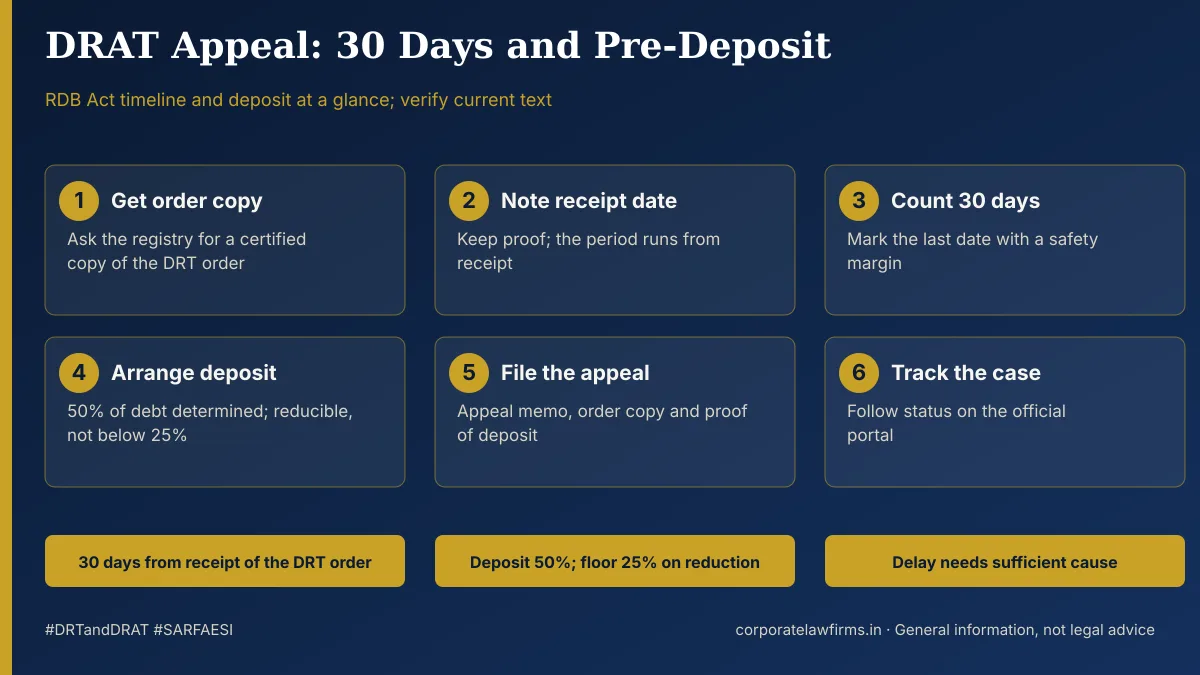
DRAT appeal limitation and pre-deposit are the two points that decide whether an appeal is even heard. Under the Recovery of Debts and Bankruptcy Act, 1993 (the RDB Act), an appeal to the Debts Recovery Appellate Tribunal is filed within 30 days. The appellant must also deposit a part of the debt.
The figures below reflect the Act as generally understood. Always verify the current text on India Code before you file.
Key Takeaways
- Appeal period under the RDB Act: 30 days from receipt of the DRT order (Section 20).
- Pre-deposit: 50 percent of the debt determined by the DRT (Section 21).
- The Appellate Tribunal may reduce the deposit, but not below 25 percent.
- SARFAESI Section 18 has a similar appeal and deposit scheme.
- A delayed appeal needs sufficient cause. It is not a right.
What is the time limit for a DRAT appeal?
Section 20 of the RDB Act allows a person aggrieved by an order of the DRT to appeal to the Appellate Tribunal. The appeal must be filed within 30 days from the date on which a copy of the order is received. The same Section lets the Appellate Tribunal admit an appeal after that period if there was sufficient cause for the delay.
Count from the date of receipt of the order, not the date it was passed. Keep proof of receipt. If a copy was served late, that proof matters.
What is the pre-deposit under Section 21?
Section 21 sets a condition for entertaining an appeal. Where the appeal is by a debtor, the appellant must deposit a part of the amount of debt due as determined by the DRT. The Act fixes this at 50 percent.
The Appellate Tribunal can, for reasons recorded in writing, reduce the amount. It cannot go below 25 percent of the debt determined. Whether a deposit is needed and in what form are matters of the statute and the tribunal’s directions. Verify with the current Act.
How does SARFAESI Section 18 work?
Where the DRT decides an application under Section 17 of the SARFAESI Act, a person aggrieved may appeal to the Appellate Tribunal under Section 18. There is a time limit for the appeal and a deposit condition tied to the secured creditor’s claim or the amount the DRT determined. The tribunal may reduce the amount, subject to a floor.
Because the figures differ from the RDB Act in wording, read Section 18 itself. For the first-stage remedy, see SARFAESI Section 17 appeal to DRT.
RDB Act and SARFAESI at a glance
| Point | RDB Act appeal | SARFAESI Section 18 appeal |
|---|---|---|
| Order appealed | DRT order under the RDB Act | DRT order under Section 17 |
| Time limit | 30 days from receipt (Section 20) | A fixed period stated in Section 18; verify |
| Deposit | 50 percent of debt determined (Section 21) | A percentage linked to the claim or amount determined; verify |
| Reduction | Not below 25 percent | Subject to a floor; verify |
| Late appeal | Sufficient cause | Check the Section text |
Can delay be condoned?
The RDB Act speaks of sufficient cause. In general terms, the tribunal looks at whether the appellant acted with care, and whether the explanation is honest and supported by facts. Delay without reasons is unlikely to be excused. Do not plan on condonation. File in time.
What happens if the deposit is not made?
The appeal may not be entertained. The tribunal can give a short time or direct how the deposit is to be made. Do not assume that time will be given. Arrange funds early. If the amount is large, ask your advocate whether a reduction can be sought, and on what grounds.
What is the usual appeal process?
- Obtain a certified copy of the DRT order.
- Note the date of receipt and compute the last date.
- Prepare the appeal memo with grounds.
- Arrange the pre-deposit.
- File before the Appellate Tribunal with the required papers.
- Track the case. See DRAT case status check.
The wider process, with practical points, is in DRT appeals in DRAT. To place the two forums, read DRT vs DRAT.
What lies after the DRAT?
The statutes do not provide a further appeal. Limited remedies exist. See appeal from DRAT to High Court. The subject sits within insolvency, bankruptcy and debt recovery.
Common mistakes
- Counting the 30 days from the date of the order, not receipt.
- Filing without arranging the pre-deposit.
- Assuming delay will be condoned.
- Reading the RDB Act rule into a SARFAESI appeal without checking Section 18.
- Filing at the wrong DRAT location.
- Not keeping proof of the date of receipt.
Documents required
- Certified copy of the DRT order and proof of its receipt.
- Appeal memo with grounds.
- Proof of pre-deposit.
- Copies of key documents filed before the DRT.
- Vakalatnama and court fee or filing charges as the tribunal requires.
What should you do next?
Check the date on which you received the order, and compute the last date today. Then plan the deposit. Rules, forms and fees change, so verify them on drt.gov.in.
Practical tips for preparing the appeal record
- Get a certified copy of the order on the day it is pronounced or uploaded.
- Mark the date of receipt of the certified copy on your file.
- Prepare a clear statement of the debt amount used to work out the pre-deposit.
- Arrange the bank proof of deposit before the appeal is listed.
- Keep a short chronology of dates for the bench.
Check the forum details in the guide on DRAT Chennai location and jurisdiction. For the next stage, read appeal from DRAT to High Court. Verify the current rules on drt.gov.in.
For general information on your matter, you may contact the firm.
This article is general information, not legal advice. Reading it does not create an advocate-client relationship.
Frequently Asked Questions
What is the time limit to appeal to DRAT?
How much pre-deposit is needed for a DRAT appeal?
Can a late DRAT appeal be heard?
Does the SARFAESI Act have a similar rule?
Topics: DRT & DRATSARFAESI
Related reading
- DRT vs DRAT: Key Differences in Powers and Appeals
- DRAT Appeal: Process, Time Limit and Pre-Deposit
- SARFAESI Section 17 Appeal to DRT: 45 Days, Remedies
- Appeal from DRAT to High Court: Writ Route and Limits
- DRAT Case Status Check: How to Track an Appeal Online
- DRAT Chennai Location and Jurisdiction: What to Verify
This article is general information, not legal advice. Reading it does not create an advocate-client relationship. Read the disclaimer. Official sources: India Code, Bar Council of India.