SARFAESI Section 17 Appeal to DRT: 45 Days, Remedies
By Adv. Saravvanan R, Advocate · Reviewed by Advocate · Updated · 7 min read · Insolvency & Bankruptcy
Short answer
Under Section 17 of the SARFAESI Act, a borrower or any aggrieved person may apply to the Debts Recovery Tribunal within 45 days of the secured creditor's measures under Section 13(4), such as taking possession. The DRT examines whether the measures follow the Act and may set them aside and restore possession.
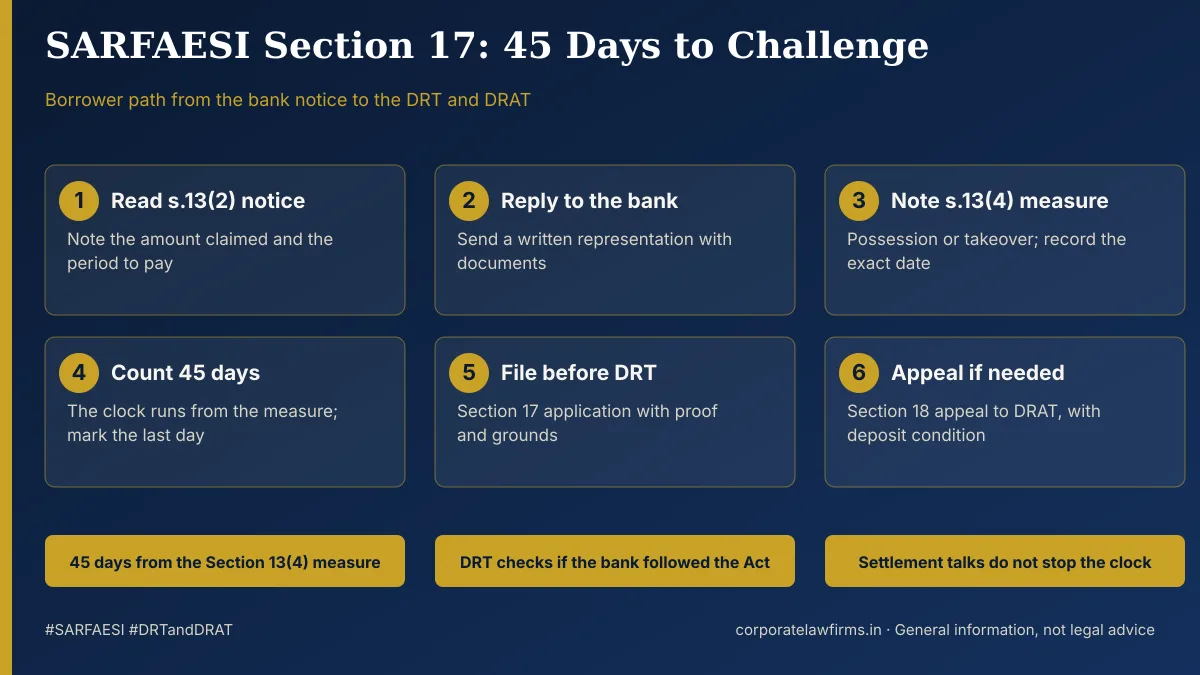
A SARFAESI Section 17 appeal to DRT is the main remedy for a borrower or any aggrieved person when a secured creditor takes action under Section 13(4) of the SARFAESI Act, 2002. The application must be made to the Debts Recovery Tribunal within 45 days of the measure. The Act is long and has been amended, so verify the current text on India Code.
Key Takeaways
- Section 17 lets an aggrieved person challenge measures taken under Section 13(4).
- The period is 45 days from the date of the measure.
- The DRT checks if the bank followed the Act and the rules.
- It can set aside the measures and restore possession.
- A further appeal lies to the DRAT under Section 18.
What leads to a Section 17 application?
The SARFAESI Act lets banks and financial institutions enforce security without going to court, where the loan is classified as a non-performing asset. The process normally runs in these stages:
- A demand notice under Section 13(2), giving the borrower a period to pay, generally 60 days.
- The borrower may send objections or a representation, and the secured creditor is expected to reply with reasons.
- If the dues remain unpaid, the creditor may take one or more measures under Section 13(4).
Those measures include taking possession of the secured asset, taking over management of the business, appointing a manager and requiring debtors of the borrower to pay the creditor. A Section 17 application challenges such measures.
Who can file under Section 17?
The borrower can file. So can any other person who is aggrieved by the measures, such as a guarantor, a mortgagor or someone who claims an interest in the property. The application is filed before the DRT that has jurisdiction. The Act and the rules decide the territorial link, which is usually tied to where the asset lies or where the bank branch is located. Verify the current rule.
What is the time limit?
The period is 45 days from the date on which the measure is taken. Count from the date of possession or the date of other measure, not from the date of the first notice. Keep the possession notice, the panchnama or other proof.
Do not wait for settlement talks to end before you file. The tribunal’s power to condone delay in a Section 17 matter is a legal question, and you should not plan on it. See DRT case status check online to follow your case once filed.
What grounds can a borrower raise?
| Ground | Example in plain terms |
|---|---|
| Defective notice | The demand notice was not properly issued or was unclear |
| Wrong classification | The loan was wrongly declared an NPA |
| No reply to objections | The bank did not consider the borrower’s representation |
| Wrong amount | The claimed dues include charges not due |
| Procedure breach | Possession or sale did not follow the rules |
| Asset outside the Act | The asset or loan is outside the scope of the Act |
Each ground needs documents and proof. The tribunal looks at the record.
What can the DRT do?
The DRT examines whether the measures were in accordance with the Act and the rules. If not, it may declare them invalid and restore possession or management to the borrower. It may also pass interim orders, such as stopping a sale for a time, usually on conditions, which may include a deposit. If it finds that the bank acted properly, it can dismiss the application.
The Act expects quick disposal. In practice, the time depends on the tribunal’s load. Verify the current position, and see DRT solutions for corporate debt recovery.
What are the borrower remedies after a bank notice?
- Read the notice and note every date.
- Send a written reply or representation to the bank.
- Explore a one-time settlement, if suitable, without letting the 45 days pass.
- File the Section 17 application in time.
- Seek interim protection if a sale is near.
- Appeal under Section 18 if the DRT rules against you.
A civil court generally cannot hear matters that the DRT can decide under the Act. So the DRT is the first forum.
What happens after the DRT decides?
A person aggrieved by the DRT’s order may appeal to the DRAT under Section 18. The appeal has its own time limit and deposit condition. Read DRAT appeal limitation and pre-deposit and DRT vs DRAT. After that, only limited remedies remain. See appeal from DRAT to High Court.
Common mistakes
- Missing the 45 days while negotiating.
- Counting from the wrong date.
- Not keeping the possession notice and other proof.
- Ignoring the demand notice and the reply stage.
- Filing in the wrong DRT.
- Assuming that an interim stay is automatic.
- Mixing up lenders’ notices and the early legal notice stage. See legal notice for recovery of money from a company.
Documents required
- Loan agreement, security documents and statements of account.
- Demand notice under Section 13(2) and the borrower’s reply.
- The bank’s reply and any possession notice.
- Proof of the date of the measure.
- Property and valuation papers, if the sale is planned.
- Vakalatnama and the prescribed fee.
What should you do next?
Note the date of the measure and compute the 45th day today. Collect the documents and speak to an advocate while time remains. Rules, fees and forms change, so verify them on drt.gov.in. The related disputes with banks are discussed in corporate banking disputes. The overview is in insolvency, bankruptcy and debt recovery.
For general information on your matter, you may contact the firm.
This article is general information, not legal advice. Reading it does not create an advocate-client relationship.
Frequently Asked Questions
What is the time limit under Section 17 of the SARFAESI Act?
Who can file a Section 17 application?
Can the DRT cancel the bank's action?
Where do I go if the DRT rules against me?
Topics: SARFAESIDRT & DRAT
Related reading
- DRAT Appeal Limitation and Pre-Deposit: 30 Days, 50%
- DRT vs DRAT: Key Differences in Powers and Appeals
- DRT Case Status Check Online: Steps and Details Needed
- DRT Debt Recovery: How Debt Recovery Tribunals Work
- Legal Notice for Recovery of Money From a Company: Guide
- Corporate Banking Disputes: Legal Remedies in India
- Appeal from DRAT to High Court: Writ Route and Limits
This article is general information, not legal advice. Reading it does not create an advocate-client relationship. Read the disclaimer. Official sources: India Code, Bar Council of India.