DRT vs DRAT: Key Differences in Powers and Appeals
By Adv. Saravvanan R, Advocate · Reviewed by Advocate · Updated · 5 min read · Insolvency & Bankruptcy
Short answer
The Debts Recovery Tribunal (DRT) hears recovery applications by banks and challenges to SARFAESI action at first instance. The Debts Recovery Appellate Tribunal (DRAT) hears appeals against DRT orders. So DRT is the trial-level forum and DRAT is the appeal forum under the RDB Act and SARFAESI Act.
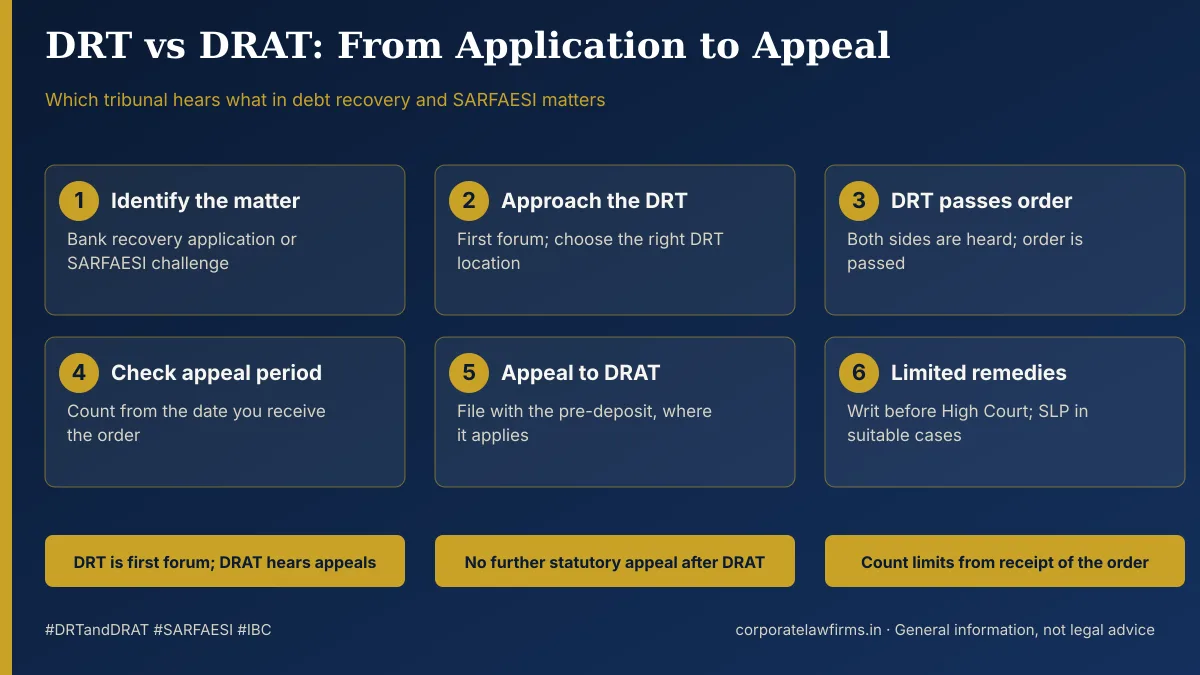
DRT vs DRAT is a common question for borrowers and lenders. The Debts Recovery Tribunal (DRT) is the first forum. The Debts Recovery Appellate Tribunal (DRAT) hears appeals from the DRT. Both are created under the Recovery of Debts and Bankruptcy Act, 1993 (the RDB Act).
This guide explains the split in plain terms. Laws and notifications change, so verify details on indiacode.nic.in and drt.gov.in.
Key Takeaways
- DRT is the first-instance forum. DRAT is the appeal forum.
- Banks and financial institutions file recovery applications before the DRT.
- Borrowers challenge SARFAESI action before the DRT, and then appeal to DRAT.
- There is no further statutory appeal from DRAT.
- Time limits and pre-deposit rules apply to appeals.
What is the Debts Recovery Tribunal (DRT)?
The DRT decides applications by banks and financial institutions for recovery of debts. The RDB Act applies when the debt is above a monetary threshold fixed by notification. The threshold has been stated as Rs 20 lakh, but verify the current figure.
The DRT also hears applications under Section 17 of the SARFAESI Act. A borrower files these against the secured creditor’s measures. See SARFAESI Section 17 appeal to DRT for the time limit and the remedies.
What is the Debts Recovery Appellate Tribunal (DRAT)?
The DRAT hears appeals against orders of the DRT. Under the RDB Act, an appeal to the Appellate Tribunal lies within the time stated in the Act. Under the SARFAESI Act, a further appeal lies against the DRT’s order passed under Section 17.
A DRAT appeal is not a fresh trial. The tribunal reviews the order and the record. For the time limit and deposit, read DRAT appeal limitation and pre-deposit.
What are the differences between DRT and DRAT?
| Point | DRT | DRAT |
|---|---|---|
| Level | First instance | Appellate |
| Main work | Recovery applications; SARFAESI challenges | Appeals from DRT orders |
| Who files | Banks, financial institutions, borrowers | Party aggrieved by a DRT order |
| Pre-deposit | Not a feature of the main application | Required for appeals, as the statutes provide |
| Further remedy | Appeal to DRAT | Writ before High Court; SLP in suitable cases |
| Seats | Several cities across India | Chennai, Delhi, Mumbai, Kolkata and Allahabad |
The seats shown for DRAT are the ones generally known. Verify on the official site, as notifications may change them. See DRAT Chennai location and jurisdiction.
How does a case move from DRT to DRAT?
- The bank files an application, or the borrower files a Section 17 application, before the DRT.
- The DRT hears the parties and passes an order.
- A party who is aggrieved files an appeal before the DRAT within the statutory period.
- The appellant meets the pre-deposit condition, where it applies.
- The DRAT hears the appeal and passes its order.
For the process and common issues, see DRT appeals in DRAT.
What happens after DRAT?
The statutes do not provide a further appeal. A party may consider a writ petition before the High Court, which is a limited, discretionary remedy. In suitable cases, the Supreme Court may be approached. Read appeal from DRAT to High Court for the limits.
How do DRT and DRAT relate to NCLT and IBC?
They are different forums. Corporate insolvency under the Insolvency and Bankruptcy Code goes to the NCLT, with appeals to the NCLAT. The DRT and DRAT are given a role for individuals and firms under Part III of the Code, to the extent it has been brought into force. For the corporate route, see Section 7 and Section 9 of the IBC.
A lender often has a choice between recovery before the DRT and insolvency before the NCLT. The choice depends on the debt, the security and the debtor. This is a legal strategy question for an advocate.
Who sits on these tribunals?
Each DRT is headed by a Presiding Officer. The DRAT is headed by a Chairperson. Both are tribunals with powers of a civil court for many purposes, but they follow their own rules of procedure under the RDB Act. They are not bound by every technical rule of the Code of Civil Procedure, though natural justice applies.
Common mistakes
- Filing an appeal at DRAT without a DRT order.
- Treating DRAT as a place to lead fresh evidence as of right.
- Missing the appeal period.
- Ignoring the pre-deposit condition.
- Choosing the wrong DRT or DRAT location.
- Assuming a writ is a normal appeal. It is not.
Documents required
- Certified copy of the order challenged.
- The original application or the SARFAESI notice.
- Loan and security documents.
- Proof of the date of receipt of the order.
- Proof of pre-deposit, if an appeal is filed.
What should you do next?
First identify where your matter stands. If a DRT order has been passed, note the date you received it and check the appeal period. If a bank notice has come, check the time limit to approach the DRT. The wider topic is explained in insolvency, bankruptcy and debt recovery, and the tribunal work is covered in DRT solutions for corporate debt recovery.
Practical tips when choosing between the two forums
Start with the stage of the matter. A fresh recovery claim or a SARFAESI challenge by a borrower goes to the DRT. An appeal against a DRT order goes to the DRAT.
Check the limitation period before anything else. Then confirm the pre-deposit rule that applies to your appeal. The cause list and orders are on drt.gov.in.
Related reading: SARFAESI Section 17 appeal to DRT, DRT case status check and appeal from DRAT to High Court.
For general information on your matter, you may contact the firm.
This article is general information, not legal advice. Reading it does not create an advocate-client relationship.
Frequently Asked Questions
What is the main difference between DRT and DRAT?
Can I go straight to DRAT?
Where do I go after DRAT?
Do DRT and DRAT deal with insolvency?
Topics: DRT & DRATSARFAESIIBC
Related reading
- DRAT Appeal Limitation and Pre-Deposit: 30 Days, 50%
- SARFAESI Section 17 Appeal to DRT: 45 Days, Remedies
- DRAT Chennai Location and Jurisdiction: What to Verify
- Appeal from DRAT to High Court: Writ Route and Limits
- DRAT Appeal: Process, Time Limit and Pre-Deposit
- DRT Debt Recovery: How Debt Recovery Tribunals Work
- IBC Section 7 and Section 9: Insolvency Explained
This article is general information, not legal advice. Reading it does not create an advocate-client relationship. Read the disclaimer. Official sources: India Code, Bar Council of India.