Appeal from DRAT to High Court: Writ Route and Limits
By Adv. Saravvanan R, Advocate · Reviewed by Advocate · Updated · 7 min read · Insolvency & Bankruptcy
Short answer
There is no statutory appeal from a DRAT order to the High Court. A party may file a writ petition under Article 226 or 227 of the Constitution, which is a limited and discretionary review of legality and fairness, not a fresh appeal. In suitable cases, the Supreme Court may be approached under Article 136.
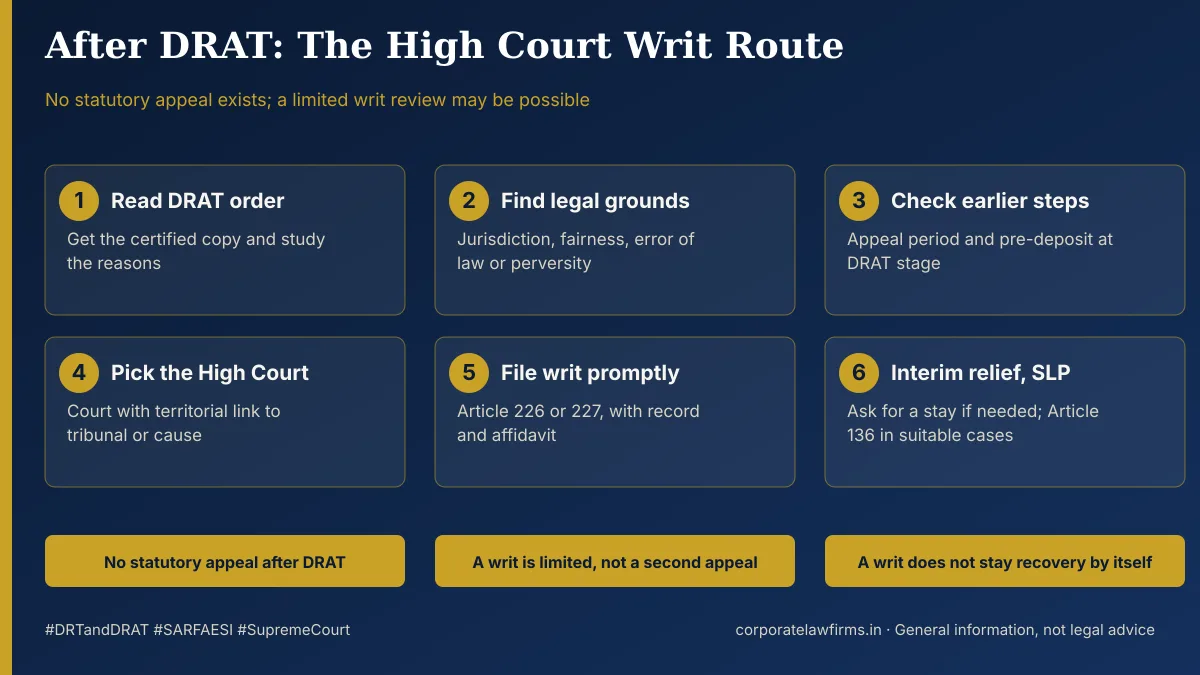
An appeal from DRAT to High Court is not provided by statute. The Recovery of Debts and Bankruptcy Act, 1993 and the SARFAESI Act give no further appeal after the Appellate Tribunal. A party who is unhappy can consider a writ petition before the High Court, and in suitable cases, a special leave petition before the Supreme Court.
This guide explains what those routes are and, more importantly, what they are not. Confirm the current law on India Code and the relevant court websites.
Key Takeaways
- No statutory appeal lies from the DRAT to the High Court.
- A writ petition under Article 226 or 227 is the usual route.
- A writ is a limited review. It is not a second appeal on facts.
- The remedy is discretionary, and delay can defeat it.
- The Supreme Court may be approached under Article 136 in suitable cases.
Is there an appeal from DRAT to High Court?
No. The statutes set the chain of forums as the DRT and then the DRAT. They stop there. See DRT vs DRAT for the structure.
Tribunal decisions are not beyond judicial review. The Constitution gives the High Courts power to review them through writ jurisdiction. That is why most challenges to a DRAT order come as a writ petition.
What is a writ against a DRAT order?
Article 226 lets a High Court issue writs, such as certiorari, to correct errors by tribunals within its territory. Article 227 gives the High Court superintendence over tribunals in its area. A petition invokes one or both.
The court asks whether the tribunal acted within its powers and followed a fair process. It does not ordinarily decide the case again on the evidence.
What grounds are usually raised?
| Ground | In simple terms |
|---|---|
| Lack of jurisdiction | The tribunal had no power to decide the matter |
| Breach of natural justice | A party was not heard or was denied a fair chance |
| Error of law apparent | The order ignores or misreads a clear legal provision |
| Perversity | The finding is one no reasonable person could reach |
| Procedural illegality | A mandatory step, such as the pre-deposit rule, was misapplied |
Mere disagreement with the findings is not a ground. A writ court is slow to interfere with findings of fact.
How is a writ different from an appeal?
An appeal is a statutory right and can review facts and law. A writ is a constitutional remedy and is discretionary. The court may refuse to hear it if there was an alternative remedy that was not used, or if the petitioner came late. It may also decline to interfere where the statute creates a special tribunal system with its own appeals.
The pre-deposit and appeal period are therefore important at the DRAT stage itself. A party who loses the appeal for default may find the writ court unwilling to help. Read DRAT appeal limitation and pre-deposit with care.
Which High Court should you approach?
Article 226 allows a petition in the High Court within whose territory the cause of action arises, in whole or in part. The tribunal’s seat is usually the safest guide. For an order of the Chennai DRAT, this is commonly the Madras High Court. For details on the Chennai seat, see DRAT Chennai location and jurisdiction.
Do not guess. Territorial questions can delay a case. Your advocate should check the cause of action and the court’s rules.
Is there a time limit for a writ?
Article 226 does not fix a period like a statute of limitation. Courts still expect the petition to be filed without undue delay. Long delay can lead to dismissal on the ground of laches. File as soon as the order and the grounds are ready.
Can you go to the Supreme Court?
Article 136 gives the Supreme Court power to grant special leave to appeal from tribunal orders. It is a discretionary power used for important questions of law or serious injustice. Parties often go to the High Court first, but the position depends on the facts. For more on how matters reach that court, see corporate matters before the Supreme Court.
Orders of the High Court in a writ may also be challenged further in the manner the law and the court rules allow. Verify the route for your case.
Does a writ stop recovery?
Not automatically. Filing a writ does not stay the DRAT order. A party who needs protection must seek an interim order from the court, and the court decides on the facts. Meanwhile, recovery steps may continue. See High Court matters for an overview of how corporate cases are handled there.
Common mistakes
- Treating the writ as a regular appeal on facts.
- Waiting many months before filing.
- Ignoring the pre-deposit at the DRAT stage.
- Filing in a High Court with no territorial link.
- Assuming an interim stay will follow the filing.
- Not placing the full record before the court.
Documents required
- Certified copies of the DRAT and DRT orders.
- Appeal memo and pleadings from the earlier stages.
- Loan, security and notice documents.
- Proof of any deposit made.
- Affidavit and the grounds of the writ.
What should you do next?
Get the certified copy of the DRAT order and note its date. List the legal points that you wish to raise, and test them against the limited scope of a writ. For the first stages of the matter, read DRT appeals in DRAT. The overview of the subject is in insolvency, bankruptcy and debt recovery.
For general information on your matter, you may contact the firm.
This article is general information, not legal advice. Reading it does not create an advocate-client relationship.
Frequently Asked Questions
Is there an appeal from DRAT to the High Court?
What grounds can a writ against a DRAT order raise?
Which High Court should I approach?
Can I go to the Supreme Court directly?
Topics: DRT & DRATSARFAESISupreme Court
Related reading
- DRAT Appeal Limitation and Pre-Deposit: 30 Days, 50%
- DRT vs DRAT: Key Differences in Powers and Appeals
- DRAT Appeal: Process, Time Limit and Pre-Deposit
- SARFAESI Section 17 Appeal to DRT: 45 Days, Remedies
- DRAT Case Status Check: How to Track an Appeal Online
- Corporate Cases in the Supreme Court of India: A Guide
- Corporate Matters in the High Court: Routes and Procedure
This article is general information, not legal advice. Reading it does not create an advocate-client relationship. Read the disclaimer. Official sources: India Code, Bar Council of India.