DRAT Case Status Check: How to Track an Appeal Online
By Adv. Saravvanan R, Advocate · Reviewed by Advocate · Updated · 6 min read · Insolvency & Bankruptcy
Short answer
A DRAT case status check is done on the official DRT website (drt.gov.in), where you choose the Appellate Tribunal, enter the appeal number and year or party name, and read the stage, next date and orders. Portal menus change often, so confirm the current steps on the site itself.
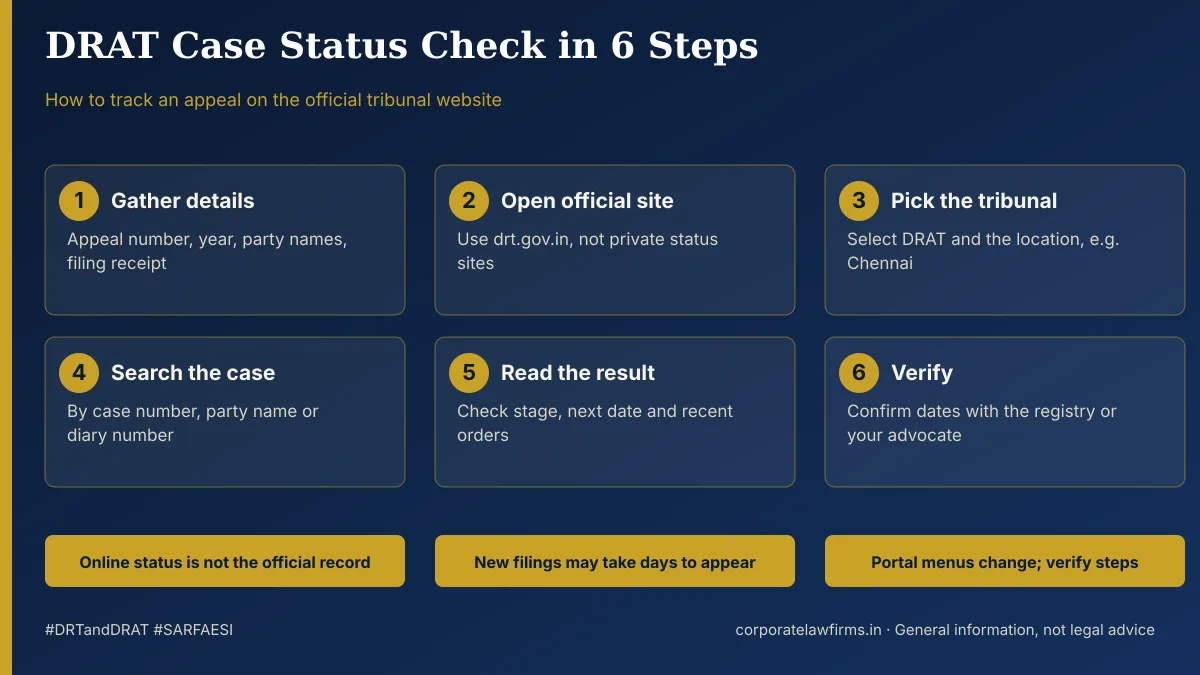
A DRAT case status check lets you see where an appeal stands before the Debts Recovery Appellate Tribunal. You can find the next hearing date, the last order and whether any defect is pending. The usual route is the official tribunal website, drt.gov.in.
A note first. Government portals change their menus, search fields and links often. This article explains the general method, not a fixed click-by-click path. Verify the current steps on the site itself.
Key Takeaways
- The DRAT hears appeals from orders of the Debts Recovery Tribunals (DRT).
- Status is shown on the official DRT website, not on private sites.
- Keep the appeal number, year and party name ready.
- A new filing may take time to show up online.
- The online screen is a convenience. The certified order and the registry record are final.
What is a DRAT case status check?
An appeal against a DRT order goes to the Appellate Tribunal. If you want to know the difference between the two forums, read DRT vs DRAT. A status check simply shows the stage of that appeal.
Most status pages show the case number, parties, date of filing, next date, stage and recent orders. The exact fields depend on the portal at the time you look.
What details do you need before you search?
Collect these before you open the portal. It saves repeated attempts.
- Name of the Appellate Tribunal (for example, the one at Chennai).
- Appeal number and year, as written on the filing receipt or notice.
- Names of the appellant and respondent, spelt as in the appeal.
- The original DRT case number, if the portal asks for it.
- The diary or filing number, if the appeal is new.
How do you check DRAT case status online?
The steps below describe the usual flow. Menus may be named differently today.
- Open the official DRT website at drt.gov.in.
- Look for the case status, case search or similar option.
- Choose the Appellate Tribunal (DRAT) and the location, such as Chennai.
- Pick the search type: case number, party name or diary number.
- Enter the details and the captcha, if one is shown.
- Open the result to see the stage, next date and orders.
Some tribunal data may also be reachable through the wider eCourts system. Do not assume every tribunal appears there. Check what the DRT site links to at present.
What does the status screen usually show?
| Item | What it tells you |
|---|---|
| Case number and year | Identifies your appeal |
| Parties | Appellant and respondent names |
| Date of filing | When the appeal was registered |
| Stage | For example, admission, notice, hearing or reserved for orders |
| Next date | The next listing, which can change |
| Orders | Daily orders or final order, where uploaded |
Treat the next date as indicative. Benches reschedule, and an order passed that day may not be uploaded for some time.
Can you check DRAT Chennai case status separately?
Yes, in the sense that you select the Chennai Appellate Tribunal in the search. For the location and the area it serves, see DRAT Chennai location and jurisdiction. Always confirm jurisdiction details on the official site.
What if the case does not appear online?
This happens more often than people expect. Work through the list below.
- The appeal may be very new. Try again after a few days.
- The year or number may be wrong. Recheck the receipt.
- The party name may be spelt differently. Try a short part of the name.
- The wrong tribunal may be selected. Check the location again.
- Data may not be uploaded yet. Contact the registry or your advocate.
If the appeal was filed but defects were raised, it may be listed only after the defects are cured. Also check the time limits and the pre-deposit rules in DRAT appeal limitation and pre-deposit, because a defect can lead to dismissal.
How should you use the status information?
Use it to plan, not to decide. If the next date is close, confirm it with your advocate. If an order is shown, get the certified copy. If you plan a further step, read appeal from DRAT to High Court for the limits of that remedy.
For the full appeal process, see DRT appeals in DRAT. For a first-instance case, the companion guide is DRT case status check online. The wider subject is covered in insolvency, bankruptcy and debt recovery.
Common mistakes
- Using a private website that claims to show tribunal status.
- Searching with the DRT case number in the DRAT field, or the reverse.
- Relying on the next date without confirming it.
- Ignoring a defect notice because the case still shows as pending.
- Missing the time to deposit or to file a reply because the portal looked quiet.
- Treating the online status as a certified record.
Documents and details required
- Filing receipt or acknowledgement of the appeal.
- Copy of the DRT order appealed against.
- Appeal number, year and diary number.
- Vakalatnama or authority letter, if someone checks on your behalf.
- Any notice or defect memo received from the registry.
What should you do next?
Note the next date, the stage and any directions. Set reminders a few days before each date. If the portal and the notice disagree, trust the notice and the registry, and verify before acting. Rules, forms and portals are revised from time to time, so check the official site each time.
For general information on your matter, you may contact the firm.
This article is general information, not legal advice. Reading it does not create an advocate-client relationship.
Frequently Asked Questions
Where can I check my DRAT case status?
What details do I need for a DRAT case status check?
Why does my DRAT appeal not show on the portal?
Is the online status an official record?
Topics: DRT & DRATSARFAESI
Related reading
- DRT Case Status Check Online: Steps and Details Needed
- DRT vs DRAT: Key Differences in Powers and Appeals
- DRAT Chennai Location and Jurisdiction: What to Verify
- DRAT Appeal Limitation and Pre-Deposit: 30 Days, 50%
- DRAT Appeal: Process, Time Limit and Pre-Deposit
- Appeal from DRAT to High Court: Writ Route and Limits
This article is general information, not legal advice. Reading it does not create an advocate-client relationship. Read the disclaimer. Official sources: India Code, Bar Council of India.