Cost to File a CAT Case: Components Explained
By Adv. Saravvanan R, Advocate · Reviewed by Advocate · Updated · 6 min read · Business & Commercial Litigation
Short answer
The cost to file a CAT case has several parts: the prescribed application fee under the Tribunal's rules, paper book and copy charges, process and service costs, advocate fees, and travel. The official fee is small compared with professional and incidental costs. Fees and rules change, so confirm the current amount with the bench registry.
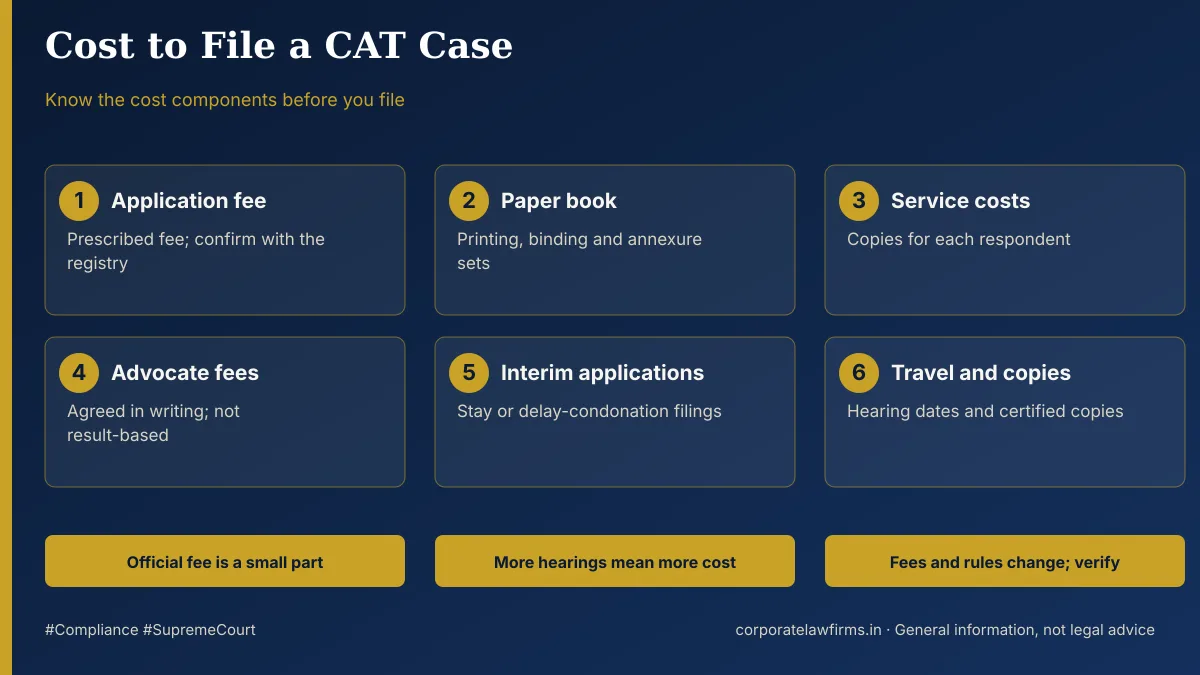
The cost to file a CAT case is made up of the prescribed filing fee, paper book and copy charges, service costs, advocate fees and travel. No single figure fits every case, so this guide explains each component and what drives it instead of quoting amounts that may be out of date.
The Central Administrative Tribunal (CAT) decides service disputes of central government employees under the Administrative Tribunals Act, 1985. It is designed to be more accessible and less formal than a civil court. Even so, a matter has real costs, and planning for them early avoids stress later.
Key Takeaways
- The official application fee is only one small part of the total cost.
- Advocate fees, drafting and paper book work usually form the larger share.
- Cost rises with the number of hearings, interim applications and the length of the matter.
- Check the current fee and payment mode with the bench registry or on cgat.gov.in.
- Get a written fee understanding with your counsel before you start.
What does it cost to file a CAT case?
Think of the total cost in layers. The first layer is what you pay to the Tribunal. The second is what you pay to prepare and present the case. The third is the day-to-day expense of running the matter over months or years.
| Cost component | What it covers | What changes it |
|---|---|---|
| Application fee | Prescribed fee for the Original Application | Revised by rules from time to time |
| Paper book and copies | Printing, binding, annexures, sets for respondents | Number of pages and parties |
| Service and notice | Serving copies on respondents and standing counsel | Number of respondents |
| Drafting and advocate fees | Application, replies, rejoinder, arguments | Complexity, forum, seniority of counsel |
| Interim applications | Stay, condonation of delay, early hearing | Urgency and number of applications |
| Travel and incidentals | Travel to the bench, certified copies, notary | Distance and number of dates |
No amounts are shown because they vary by bench, year and matter. Verify each with the registry.
How much is the CAT application fee?
The Tribunal’s procedure rules fix a fee for filing an application. Miscellaneous applications and other filings may carry separate fees. The amount has been revised in the past and may be revised again.
Ask the registry of the bench where you will file, or check the official site, for the current fee. Also ask how it is to be paid, since modes can change with e-filing.
Is an advocate fee part of the cost to file a CAT case?
For most applicants, yes, and it is often the largest item. The Administrative Tribunals Act allows an applicant to appear in person or through a legal practitioner or authorised representative. Whether to engage counsel depends on the issue, your comfort with procedure and the stakes.
Advocate fees are a private agreement. They are guided by the Advocates Act, 1961 and the Bar Council of India Rules on professional conduct. An advocate cannot charge a fee that depends on the result of the case. A written understanding of the scope of work and the fee stages helps both sides. For general ideas on how lawyers structure charges, read Lawyer fees and retainer lawyer fees.
What factors make a CAT case more expensive?
- Complex subject matter. Seniority disputes, promotion, pay fixation and disciplinary matters often need more records.
- Number of respondents. Each respondent adds service work and copies.
- Interim relief. Stay or urgent hearing applications add drafting and hearings.
- Delay. A matter filed late needs an application for condonation of delay.
- Length of the matter. More hearing dates mean more appearance work and travel.
- Challenges after the Tribunal. A writ petition before the High Court is a separate proceeding with its own costs.
Documents required to file a CAT application
Preparing documents well keeps copy and drafting costs under control.
- Impugned order, memorandum or communication
- Representations made and replies, if any
- Service records, appointment and promotion orders
- Relevant rules, circulars and office memoranda
- Identity and address proof of the applicant
- Authority letter or vakalatnama if counsel is engaged
- Index and page-numbered annexures
How can you plan and control the cost?
Do the groundwork before you approach counsel. Arrange documents in date order. Write a short chronology of events. This reduces billable time.
Ask for a clear estimate of the stages: drafting, filing, reply stage, final hearing. Ask what is covered by the fee and what is charged separately, such as copies and travel. Check the status of your matter yourself, as explained in CAT case status check online.
Time is also a cost. Read how long a CAT case takes to plan.
Common mistakes
- Using an old fee amount from a blog or forum.
- Filing late, then paying extra to seek condonation of delay.
- Not asking what the advocate’s fee includes.
- Ignoring small recurring costs such as certified copies and travel.
- Assuming the other side will pay your costs.
- Choosing the wrong forum, where the matter is later dismissed for want of jurisdiction.
When should you consider CAT at all?
CAT is meant for service matters of central government employees and certain other covered persons. If the dispute is not a service matter, another forum applies. For examples of when CAT is the proper route, see Promotion Denials in Government Jobs - When to Move CAT and Central Administrative Tribunal: Your Corporate Rights Defended. The wider category of disputes is covered in Tax, Labour and Regulatory Disputes.
Official sources
Check the current fee and procedure on cgat.gov.in. Read the Administrative Tribunals Act on India Code. Rules and fees change, so confirm everything on the official sources before you act.
For general information on your matter, you may contact the firm.
This article is general information, not legal advice. Reading it does not create an advocate-client relationship.
Frequently Asked Questions
Is there a court fee for filing a CAT application?
Do I need an advocate to file a CAT case?
Can the cost of a CAT case be recovered from the other side?
Are advocate fees fixed for CAT matters?
Topics: ComplianceSupreme Court
Related reading
This article is general information, not legal advice. Reading it does not create an advocate-client relationship. Read the disclaimer. Official sources: India Code, Bar Council of India.