Retainer Lawyer Fees: How Retainers Work in India
By Adv. Saravvanan R, Advocate · Reviewed by Advocate · Updated · 6 min read · Contracts & Documentation
Short answer
Retainer lawyer fees are a periodic payment, usually monthly or annual, that keeps an advocate available for an agreed scope of work such as advice, notices, contract review and compliance support. The amount depends on scope, volume, complexity and exclusions. It is set by written agreement and cannot depend on the result of any case.
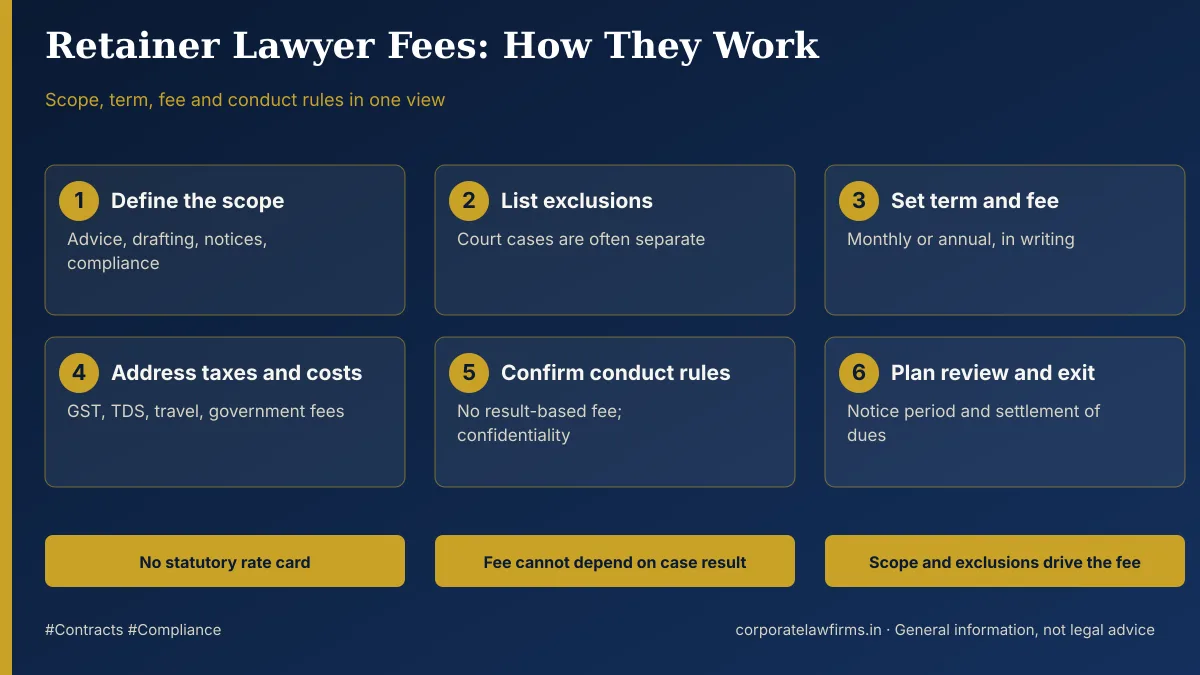
Retainer lawyer fees are a recurring payment that keeps an advocate or law firm available to a client for an agreed scope of work over a fixed term. A retainer suits businesses with regular legal needs such as contracts, notices, compliance and advice. This guide explains how retainers work, what shapes the fee and which professional conduct rules apply. No price quotes are given, since each retainer is agreed by contract.
Key Takeaways
- A retainer is a contract. Its scope, term and fee must be in writing.
- There is no statutory rate card for retainer lawyer fees.
- Litigation is often outside a basic retainer and charged separately.
- A fee that depends on the result of a case is not allowed for advocates.
- GST, TDS and out-of-pocket costs should be addressed in the agreement.
- Check scope, exclusions and the exit terms before signing.
What are retainer lawyer fees?
A retainer fee is paid at regular intervals, often monthly, for an agreed bundle of services. It is different from a fee for one task such as a single opinion or a single case.
There are two common meanings of “retainer”. In one, the fee secures the advocate’s availability and covers an agreed amount of work. In the other, it is an advance paid against future work, which is then adjusted against billing. The agreement should say which one applies.
How does a legal retainer work?
| Element | What it usually states |
|---|---|
| Parties | Client and advocate or firm |
| Term | Start date, duration, renewal |
| Scope | Services included, such as advice, notices, drafting, compliance support |
| Exclusions | Matters not covered, such as court cases or arbitrations |
| Fee | Amount, frequency, due date |
| Out-of-pocket costs | Government fees, travel, courier, translation |
| Taxes | GST and tax deduction at source, where applicable |
| Confidentiality | Duty to protect client information |
| Termination | Notice period and settlement of dues |
A well-drafted retainer prevents disputes. See Corporate Contracts and Commercial Law for how business contracts are structured in general.
What factors decide retainer lawyer fees?
- Scope of services. A narrow scope costs less effort than a broad one.
- Expected volume. The number of contracts, notices and queries per month.
- Complexity. Regulated sectors and cross-border work need more depth.
- Response time. Fast turnaround commitments need planning.
- Number of entities. A group with several companies has more work.
- Included hours or matters. Some retainers cap hours or the number of documents.
- Seniority of the lawyers. Different levels of experience are involved.
- Exclusions. The more that is excluded, the more is billed separately.
Ask for a written scope and an explanation of how excess work is handled.
What does a retainer usually cover?
Common items include:
- Day-to-day legal advice by phone or email within agreed limits
- Review and drafting of contracts and policies
- Notices and replies to notices
- ROC and compliance support
- Board meeting and resolution drafting
- Regular legal health checks
Items often excluded or priced separately are litigation, arbitration, tribunal hearings, large transactions and specialised regulatory filings. For example, tribunal work such as the NCLT Chennai Bench Filing Procedure is typically a separate engagement. For a view on why businesses keep ongoing legal support, read Why Every Business Needs a Commercial Transactions Lawyer on Speed Dial.
What do the Advocates Act and BCI Rules say about fees?
Advocates in India are governed by the Advocates Act, 1961 and the Bar Council of India Rules. Some points matter to retainer clients.
- No fee contingent on the result. An advocate cannot stipulate for a fee that depends on the outcome of litigation, or agree to share the proceeds of a case.
- Reasonable and transparent fees. The fee should be fair and clearly stated.
- Confidentiality. Client communications must be kept confidential.
- No solicitation. Advocates are restricted from advertising and soliciting work. A retainer should be entered after you have approached and assessed an advocate, not from promotional offers.
- Duty on withdrawal. An advocate who withdraws from a matter must give reasonable notice and protect the client’s interests.
These are general points. Read the current rules on the Bar Council of India website and the Advocates Act on India Code.
How are taxes and costs treated in a retainer?
Legal services to a business entity may attract GST, and in many cases the business pays it under the reverse charge mechanism. Professional fees may also attract tax deduction at source. The rules and sections change, so confirm the current position with your tax adviser.
The agreement should say whether the fee is inclusive or exclusive of taxes, and who bears government fees and travel costs.
Documents and details to prepare before a retainer
- Names and constitution of the entities to be served
- A list of recurring legal needs
- Existing contracts and policies
- Contact persons and decision-makers
- Expected volume and turnaround needs
- Any regulatory licences held
Common mistakes
- Signing without a clear scope and exclusions.
- Assuming the retainer includes court cases.
- Not defining response times and communication channels.
- Ignoring taxes and out-of-pocket costs in the budget.
- Expecting unlimited work for a fixed fee.
- Not setting a review point after a few months.
- Linking the fee to the result of a case, which is not permitted for advocates.
How does a retainer compare with a per-matter fee?
A per-matter fee suits one-off work such as a single opinion. A retainer suits a client with steady, predictable work. Compare both against your actual needs. See Lawyer fees for general fee concepts and property legal opinion fees in Chennai for an example of a per-matter fee. To choose an advocate, read How to find a good Lawyer in Chennai?. Startups can also read Startup Business Legal Tips.
For general information on your matter, you may contact the firm.
This article is general information, not legal advice. Reading it does not create an advocate-client relationship.
Frequently Asked Questions
What is a legal retainer?
How are retainer lawyer fees decided?
Can a retainer include court cases?
Can I end a retainer agreement?
Topics: ContractsCompliance
Related reading
- Lawyer Fees for Companies: Flat, Hourly and Retainer
- Property Legal Opinion Fees in Chennai: Factors
- Commercial Transactions Lawyer: Why Businesses Need One
- Corporate Contracts and Commercial Law in India
- How to Find a Good Lawyer in Chennai: Practical Guide
- Startup Business Legal Tips for Founders in India
- Arbitration Clause Drafting in India: Seat, Rules, Sample
This article is general information, not legal advice. Reading it does not create an advocate-client relationship. Read the disclaimer. Official sources: India Code, Bar Council of India.