Property Legal Opinion Fees in Chennai: Factors
By Adv. Saravvanan R, Advocate · Reviewed by Advocate · Updated · 6 min read · Real Estate
Short answer
Property legal opinion fees in Chennai are not fixed by law. They depend on the number and age of documents, the search period, the property type, site and records checks, the risks found and the time needed. The fee is agreed in writing between advocate and client. It cannot depend on the outcome.
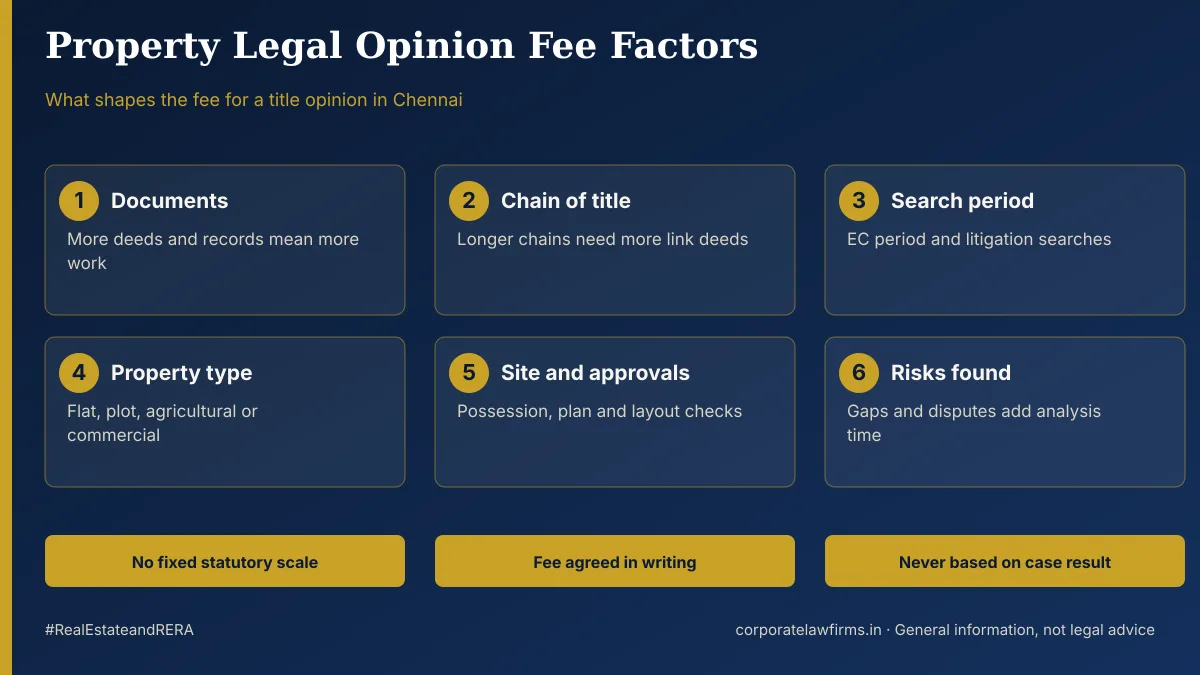
Property legal opinion fees in Chennai are a professional charge, not a fixed government rate. The amount depends on the documents to be read, the search period, the number of owners in the chain, the site checks needed and the risks found. This guide explains each factor so you can compare quotes sensibly. No fee figures are given, since they vary with every matter.
A legal opinion tells a buyer, lender or family whether the seller has a clear and marketable title. It is based on documents and searches. The format is explained in legal opinion format for property in Tamil Nadu.
Key Takeaways
- There is no statutory scale for a property legal opinion fee.
- The fee reflects the volume of documents, the search period and the complexity.
- Agree the scope and the fee in writing before work starts.
- Government and search charges are usually separate from the advocate’s fee.
- A fee dependent on the result of litigation is not permitted for advocates.
- Compare the scope of work, not only the amount.
What decides property legal opinion fees in Chennai?
| Factor | Why it affects the fee |
|---|---|
| Number of documents | More deeds and records mean more reading time |
| Length of the chain of title | Many owners need more link documents |
| Search period | A longer EC period means more entries to check |
| Type of property | Flat, plot, agricultural land and commercial property raise different issues |
| Approvals and layout | Plan approval and regulatory checks add work |
| Site visit | Possession checks need time and travel |
| Litigation search | Case searches in different courts add effort |
| Risks and gaps | A problem file needs more analysis and drafting |
| Urgency | A tight deadline can change the working schedule |
| Lender requirements | Bank format and extra reports can change the scope |
Is the fee fixed or negotiable?
The fee is a matter of agreement. The Advocates Act, 1961 and the Bar Council of India Rules set the standards of professional conduct, but they do not publish a price list for opinions. Advocates are expected to charge reasonably and transparently.
Ask for a written note that sets out the scope of work, the documents to be covered, the search period, the expected time and the fee. A clear note avoids disputes later. For general ideas on how lawyers structure charges, read Lawyer fees.
What does the fee usually cover?
- Reading the title deeds and parent documents
- Reviewing patta, chitta, FMB and tax records
- Reading the encumbrance certificate for the period
- Tracing the chain of title
- Drafting the written opinion with findings and conditions
- Clarification discussions on the opinion
Items that may be charged separately include government fees for certificates and copies, travel for site visits, translation of documents, and extra work such as drafting a sale agreement or sale deed. See Sale deed for the next stage after the opinion.
How do documents and risk change the fee?
A clean file with a short chain and complete documents takes less time. A file with missing parent deeds, family partitions, court orders, power of attorney sales or revenue mismatches takes more. The advocate may also need to ask for further documents or make inquiries.
Be honest about known problems. An accurate scope at the start leads to a fair fee and a useful opinion.
What does Bar Council compliance mean for fees?
Advocates are bound by the Bar Council of India Rules. Two points matter to clients.
- A fee must not be made to depend on the result of litigation. An advocate cannot agree to share the proceeds of a case.
- Advocates may not solicit work by advertising or offering fee discounts. So a fair way to compare is by asking for the scope and the fee note from each advocate you consult, not by looking for price offers.
For how to choose a lawyer, see How to find a good Lawyer in Chennai?.
Documents required before you ask for a fee note
- Copies of the title deeds and parent deed
- Patta, chitta, adangal and FMB extracts if available
- Encumbrance certificate, if already obtained
- Property tax receipts
- Plan approval or layout approval
- Seller details and the intended use of the opinion
- Lender requirements, if a loan is involved
Sharing these upfront lets the advocate assess the scope and give a more accurate fee note.
Common mistakes
- Choosing only on the lowest fee without checking the scope.
- Not asking what the fee includes and what is extra.
- Giving only part of the documents and later finding more are needed.
- Paying the seller before the opinion is complete.
- Using a general opinion for a bank loan when the bank needs its own format.
- Assuming the opinion guarantees the title. It is the advocate’s view on the papers seen.
Where does a property legal opinion fit in the purchase?
The opinion comes before you pay the main consideration and sign the sale deed. It helps you decide whether to proceed, negotiate, or ask the seller to cure defects. See Property Legal Opinion and the broader guide in Property and Real Estate Legal Opinion. If the property is a flat in a project, also read RERA Compliance and Valuation Dispute Solutions.
Statutes such as the Registration Act, 1908 and the Transfer of Property Act, 1882 are on India Code. The professional rules are on the Bar Council of India website. Rules and practice change, so verify on the official sites.
For general information on your matter, you may contact the firm.
This article is general information, not legal advice. Reading it does not create an advocate-client relationship.
Frequently Asked Questions
Is there a government-fixed fee for a property legal opinion?
Can an advocate charge a percentage of the property value?
Are search and registration charges part of the opinion fee?
Does a bank-approved opinion cost differently?
Topics: Real Estate & RERAContracts
Related reading
- Legal Opinion Format for Property in Tamil Nadu
- Property Legal Opinion: Documents Checked and Process
- Lawyer Fees for Companies: Flat, Hourly and Retainer
- Retainer Lawyer Fees: How Retainers Work in India
- Sale Deed in India: Drafting, Stamp Duty and Registration
- How to Find a Good Lawyer in Chennai: Practical Guide
This article is general information, not legal advice. Reading it does not create an advocate-client relationship. Read the disclaimer. Official sources: India Code, Bar Council of India.