Legal Opinion Format for Property in Tamil Nadu
By Adv. Saravvanan R, Advocate · Reviewed by Advocate · Updated · 7 min read · Real Estate
Short answer
A legal opinion format for property in Tamil Nadu lists the property and documents examined, traces the chain of title through parent and link documents, reviews patta, chitta, FMB and encumbrance certificate for about 30 years, checks mutation and possession, states risks and conditions, and ends with a clear conclusion on marketable title.
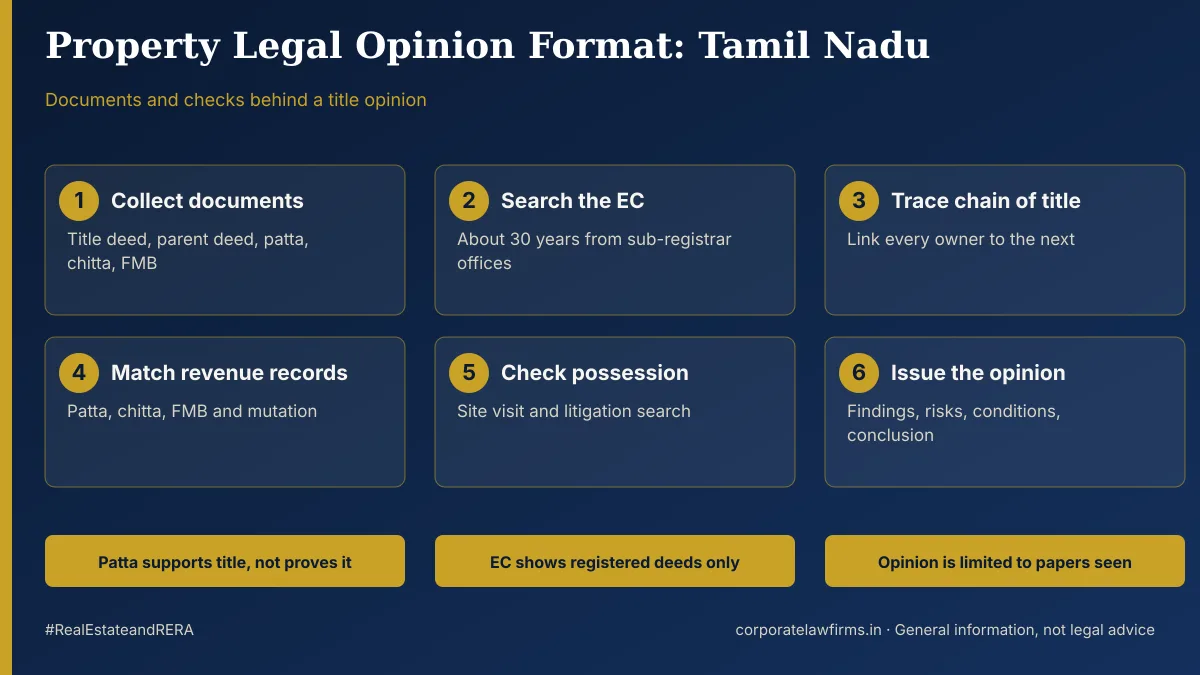
A legal opinion format for property in Tamil Nadu is a structured written report. It lists the documents examined, traces the chain of title, checks revenue records such as patta, chitta, FMB and the encumbrance certificate, and ends with a clear conclusion. This guide explains each part and gives a text template you can adapt.
The opinion is used by buyers, banks, builders and family members who need comfort on title before a sale, loan or settlement. It is an advocate’s reasoned view on the papers, not a guarantee.
Key Takeaways
- A good opinion traces the chain of title from the oldest available document to the present owner.
- Patta and chitta are revenue records. They support title but do not prove it alone.
- An encumbrance certificate (EC) for about 30 years shows registered transactions only.
- Link documents and the mother deed (parent document) must be checked for gaps.
- The opinion should state risks and conditions plainly, not just “clear title”.
- Verify current procedures on the official portals, as they change.
What is a legal opinion format for property in Tamil Nadu?
It is the standard layout in which an advocate records the scope of the search, the documents seen, the findings and the conclusion. In Tamil Nadu, the layout also reflects local records such as patta, chitta, adangal, FMB and the A-register.
The general topic is covered in Property Legal Opinion and the wider guide in Property and Real Estate Legal Opinion.
Which documents are checked for a property legal opinion?
| Document | What it shows |
|---|---|
| Title deed or sale deed | Present owner’s source of title |
| Parent (mother) document | The earlier deed from which the title flows |
| Link documents | Deeds connecting each owner in the chain |
| Patta | Person recorded for revenue purposes |
| Chitta and adangal | Land classification, extent and cultivation entries |
| FMB sketch | Survey boundaries and measurements |
| Encumbrance certificate | Registered transactions for the period searched |
| Tax receipts | Property tax or land tax paid |
| Approvals | Layout or building plan approval and similar permissions |
| Legal heir or court documents | Where title passed by succession or decree |
What is the 30-year search and chain of title?
Lawyers and banks commonly examine the title for about 30 years. The aim is to confirm that every owner in that period had a valid right to transfer. The search is a practice, not a fixed statutory period for every case.
Start with the present deed. Find its parent document. Then find the deed before that, and so on. Each deed must link to the next. A gap, such as a missing deed or an unregistered transfer, is a risk to note in the opinion.
How to read patta, chitta, FMB and EC?
- Patta: shows the name of the person in the revenue records, the survey number and extent.
- Chitta: an extract of land holding details by village, helpful for matching the survey number and area.
- FMB: the field measurement sketch. Match the boundaries and area with the deed.
- EC: lists registered documents affecting the property. Check for mortgages, sales, settlements and releases.
Names, survey numbers and extent should match across all records. Differences should be flagged, and cure steps suggested.
What is mutation and why does it matter?
Mutation is the change of name in revenue records after a transfer, such as a sale or inheritance. In Tamil Nadu this is commonly called patta transfer. If a buyer has a registered sale deed but no patta change, the revenue record still shows the old owner. This can cause problems with loans, approvals and later sales.
What does a legal opinion template for Tamil Nadu property contain?
The text below is a general layout. Replace the items in square brackets. It is not a substitute for advice on your documents.
Title: Legal Opinion on Title to the Property at [address]
- Instructions and purpose: [Name of client] has asked for an opinion for [purchase / loan / settlement].
- Property description: Survey number, village, taluk, district, extent, boundaries.
- Documents examined: List with date, document number, registration office.
- Search conducted: EC for [period] from [sub-registrar offices]; revenue records; litigation search.
- Chain of title: Owner-wise narration from [oldest document] to the present owner.
- Revenue records: Patta, chitta, FMB and mutation status.
- Possession: Findings from site inspection or declaration.
- Encumbrances and litigation: Mortgages, attachments, pending suits, notices.
- Approvals and tax: Plan approval, property tax, other dues.
- Observations and risks: Gaps, mismatches, missing documents.
- Conditions and suggestions: Documents to be obtained before completion.
- Conclusion: Whether title is clear and marketable, subject to the conditions above.
- Limitations: Based only on documents provided and searches made on [date].
Signature, name, enrolment details and date follow.
What are the common mistakes in property legal opinions?
- Relying on a photocopy of the sale deed without checking the registered copy.
- Treating patta as proof of ownership.
- Skipping the parent document, so the chain has a gap.
- Not checking the survey number against the FMB and chitta.
- Ignoring unregistered agreements, court cases and possession by others.
- Giving a “clear title” conclusion without stating limits and conditions.
- Not updating the EC to a recent date before completion.
Documents required to start the opinion
- Copies of all title deeds and the parent document
- Latest patta, chitta, adangal and FMB extracts
- EC for the period requested
- Property tax and utility receipts
- Plan approval, if any
- Legal heir certificate, will or court order where relevant
- Identity details of the seller
Registered documents are governed by the Registration Act, 1908, and transfers by the Transfer of Property Act, 1882. Read the statutes on India Code. For related topics see Sale deed and Property Disputes, Land Registration and Real Estate Legal Services.
How do fees and language relate to the opinion?
The fee depends on the work involved and is discussed in property legal opinion fees in Chennai. Many clients also want to understand the terms in Tamil. See legal opinion format in Tamil.
Check land records and registration services on the Tamil Nadu government portals, and court records on eCourts. Portals and forms change, so verify before use.
For general information on your matter, you may contact the firm.
This article is general information, not legal advice. Reading it does not create an advocate-client relationship.
Frequently Asked Questions
What is a property legal opinion in Tamil Nadu?
Why is a 30-year search commonly done?
Is patta proof of ownership?
Does an encumbrance certificate show everything?
Topics: Real Estate & RERAContracts
Related reading
- Property Legal Opinion: Documents Checked and Process
- Sale Deed in India: Drafting, Stamp Duty and Registration
- Property Legal Opinion Fees in Chennai: Factors
- Legal Opinion Format in Tamil: Key Terms Explained
- Property Disputes and Land Registration in India
- RERA Compliance and Property Valuation Disputes
- Arbitration in Property Disputes: Process and Award
This article is general information, not legal advice. Reading it does not create an advocate-client relationship. Read the disclaimer. Official sources: India Code, Bar Council of India.