Legal Opinion Format in Tamil: Key Terms Explained
By Adv. Saravvanan R, Advocate · Reviewed by Advocate · Updated · 6 min read · Real Estate
Short answer
A legal opinion format in Tamil follows the same structure as the English format: property description, documents examined, chain of title, revenue records, encumbrances, risks and conclusion. This guide explains each part in English and gives the common Tamil terms, such as பட்டா (patta), சிட்டா (chitta), அடங்கல் (adangal) and தாய் பத்திரம் (mother deed).
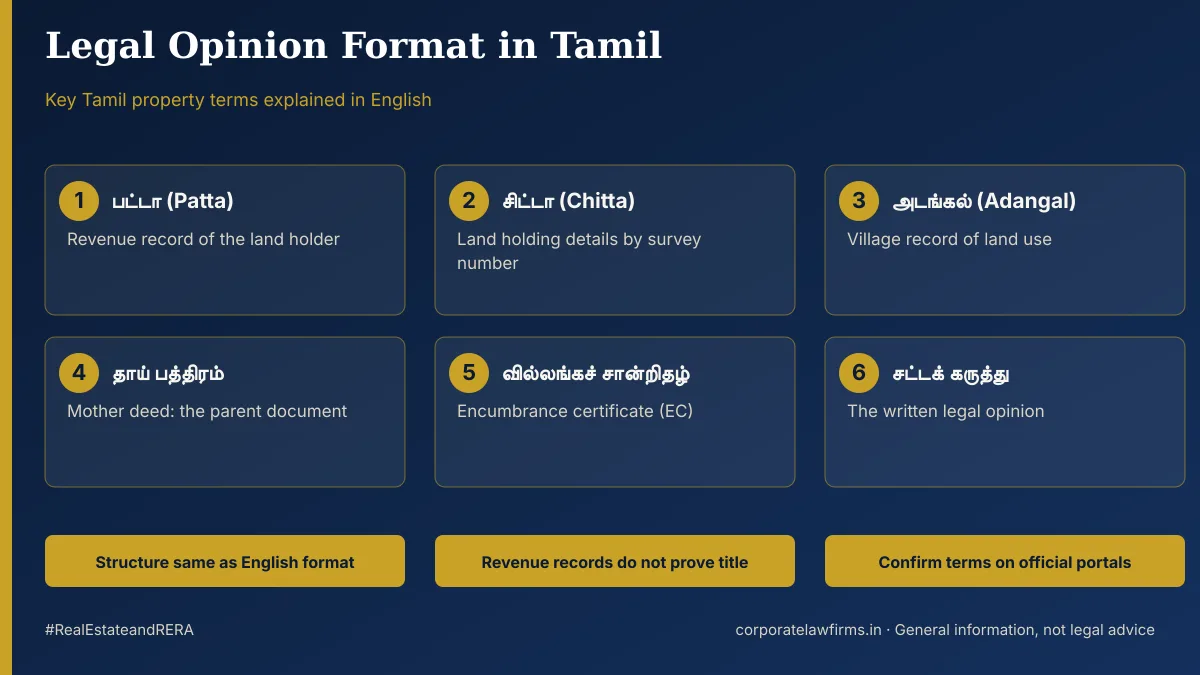
A legal opinion format in Tamil follows the same structure as an English title opinion. It describes the property, lists the documents seen, traces the chain of title, reviews revenue records and encumbrances, and ends with findings and a conclusion. This guide explains the format in plain English and gives the key Tamil terms in Tamil script.
Many property owners in Tamil Nadu read deeds and revenue records in Tamil. Knowing the Tamil terms helps you follow the opinion and ask better questions. For the full English layout and a template, read legal opinion format for property in Tamil Nadu.
Key Takeaways
- The structure of a legal opinion is the same in Tamil and in English.
- Tamil terms such as பட்டா, சிட்டா, அடங்கல் and தாய் பத்திரம் refer to specific records and must be read with care.
- Revenue records support title but do not by themselves prove ownership.
- Language choice affects how clearly you understand risks, so ask for plain wording.
- Terms may vary by region and office. Confirm the exact record name on the official portal.
What is a legal opinion in Tamil?
A legal opinion is called சட்டக் கருத்து (sattak karuthu). For property, it is a written view by an advocate on whether the seller has a clear title. It is given after reading the documents and records and making searches. It is not a guarantee.
The English term “legal opinion” is also commonly used in Tamil conversation and in bank and registry practice.
Which Tamil terms appear in a property legal opinion?
| English term | Tamil term | Meaning in brief |
|---|---|---|
| Patta | பட்டா | Revenue record of the person holding the land |
| Chitta | சிட்டா | Extract of land holding details |
| Adangal | அடங்கல் | Village record of land use and cultivation |
| Mother deed | தாய் பத்திரம் | Parent document from which title flows |
| Encumbrance certificate | வில்லங்கச் சான்றிதழ் | List of registered transactions on the property |
| Sale deed | விற்பனைப் பத்திரம் / கிரயப் பத்திரம் | Registered document of sale |
| Survey number | புல எண் / சர்வே எண் | Land identification number in revenue records |
| Village | கிராமம் | Revenue village |
| Taluk | வட்டம் | Revenue sub-division |
| Legal heir certificate | வாரிசு சான்றிதழ் | Certificate naming legal heirs of a deceased person |
| Patta transfer | பட்டா மாறுதல் | Change of name in revenue records |
| Registration | பதிவு | Registration of a document |
Local usage differs, so confirm a term with the office concerned before relying on it.
How is the legal opinion format laid out in Tamil?
The sections are the same as in English. A Tamil version commonly has these parts:
- Purpose and instructions. Who asked for the opinion and why.
- Property description. Survey number, village, taluk, district, extent and boundaries.
- Documents examined. Deeds with date, number and registration office.
- Chain of title. Owner-wise narration from the mother deed to the present owner.
- Revenue records. Patta, chitta, adangal and FMB.
- Encumbrances. Findings from the encumbrance certificate and litigation search.
- Possession. Findings on who is in possession.
- Risks and conditions. Gaps and steps to cure them.
- Conclusion. Whether title is clear and marketable, subject to conditions.
A good opinion in any language is specific. It names each document and each finding.
What is the difference between patta, chitta and adangal?
- Patta (பட்டா): shows who is recorded as holder of the land, with survey number and extent.
- Chitta (சிட்டா): gives holding details for a survey number, often used with patta to match extent and classification.
- Adangal (அடங்கல்): a village-level record that notes land use and cultivation entries.
None of these is a title deed. Ownership is shown through registered documents such as sale deeds, settlement deeds, partition deeds or court decrees. Revenue records show who is recorded in the government’s books. A lawyer compares both sets.
What is a mother deed and why does it matter?
The mother deed (தாய் பத்திரம்) is the earlier document that gave the present owner’s predecessor a valid right. If it is missing, the chain of title has a gap. The opinion should say so and suggest steps, such as getting a certified copy from the sub-registrar office or tracing the earlier owner.
The idea of a “30-year” search is a general practice used by lawyers and banks. It is not a fixed rule for all cases.
Common mistakes
- Treating patta as proof of ownership.
- Reading only the Tamil summary and skipping the full deed.
- Not matching the survey number and extent across deed, patta and chitta.
- Accepting a photocopy without checking the registered copy.
- Ignoring the missing mother deed or link documents.
- Assuming an encumbrance certificate shows unregistered agreements or court cases.
- Translating terms loosely, so that the meaning shifts.
Documents required for an opinion
- Title deed, mother deed and link documents
- Patta, chitta, adangal and FMB extracts
- Encumbrance certificate
- Tax receipts and approvals
- Legal heir certificate or will where relevant
- Identity details of the seller
How does language affect cost and use of the opinion?
An opinion may be given in Tamil or English. If a bank or authority needs English, a Tamil-only opinion may not be accepted. Translating deeds can add time and cost. Fee factors are explained in property legal opinion fees in Chennai.
For the wider topic, see Property Legal Opinion, Sale deed and Property Disputes, Land Registration and Real Estate Legal Services. To choose an advocate, read How to find a good Lawyer in Chennai?.
Read the laws on India Code. Tamil Nadu land record services have their own portals, and names of records may change. Verify on the official sites.
For general information on your matter, you may contact the firm.
This article is general information, not legal advice. Reading it does not create an advocate-client relationship.
Frequently Asked Questions
What is a legal opinion called in Tamil?
Can a legal opinion be written in Tamil?
What is a mother deed in Tamil property practice?
Is patta the same as chitta?
Topics: Real Estate & RERAContracts
Related reading
- Legal Opinion Format for Property in Tamil Nadu
- Property Legal Opinion: Documents Checked and Process
- Property Legal Opinion Fees in Chennai: Factors
- Sale Deed in India: Drafting, Stamp Duty and Registration
- Property Disputes and Land Registration in India
- How to Find a Good Lawyer in Chennai: Practical Guide
This article is general information, not legal advice. Reading it does not create an advocate-client relationship. Read the disclaimer. Official sources: India Code, Bar Council of India.